Challenges
Optimizing Maturing 5G Networks for Real-time and Actionable Insights
As 5G networks mature from Non-Standalone (NSA) to Standalone (SA), Communication Service Providers face growing operational complexity across disaggregated architectures, multi-vendor environments, and dynamic services such as network slicing and edge computing.
Traditional monitoring tools struggle to deliver:
- True end-to-end visibility across RAN, core, transport, and edge
- Real-time insight into service quality and user experience
- Actionable data to support automation, assurance, and SLA commitments
- Without comprehensive observability from the outset, CSPs experience longer mean time to knowledge, reactive operations, rising costs, and degraded customer experience.
The result is faster issue resolution, proactive service assurance, scalable automation, and improved ROI for advanced 5G services. Powering this transformation, NETSCOUT delivers real-time, end-to-end observability CSPs need to optimize and assure advanced 5G networks with confidence.

Outcomes That Matter
Observability Outcomes That Power 5G Performance and Growth
End-to-End Visibility
Monitor 5G performance from the Radio Access Network through the core and out to the edge with no blind spots.
Real-Time, Actionable Insights
Use real-time dashboards, metrics, and workflows to identify issues early and support predictive analysis.
AI-Ready, Context-Rich Data
Generate curated, packet-derived data optimized for analytics, automation, and AI/ML initiatives.
SLA Management for Network Slicing
Assure performance and monetization of network slices with precise, service-level visibility.
Automation and Scalability
Reduce operational complexity and total cost of ownership through scalable observability and automation.
NETSCOUT’s Solution and How It Works
Operational Excellence Through End-to-End 5G Network Observability
NETSCOUT’s 5G observability architecture supports seamless evolution from 5G Non-Standalone to Standalone deployments, providing continuous visibility across RAN, core, transport, and edge environments.
Using packet-based data capture and deep packet inspection, NETSCOUT correlates complex traffic flows across emerging 5G technologies and curates AI-ready data for analytics and automation.
NETSCOUT enables CSPs to:
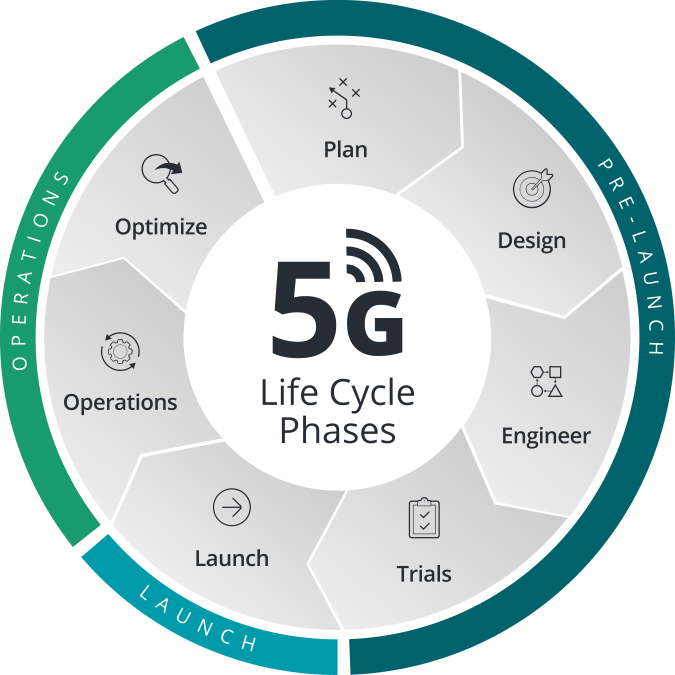
- Monitor 5G performance throughout the entire lifecycle
- Perform end-to-end session and service analysis
- Proactively assure service quality with real-time insight
- Automate advanced policies for analytics and assurance
With nGeniusONE, teams gain a unified operational view across all technologies using customizable dashboards and guided workflows for proactive maintenance and rapid troubleshooting.
5G Life Cycle Strategy Compels Innovation
5G Networks, Non-Standalone (NSA), and Standalone (SA) are maturing. CSPs, must consider a life cycle monitoring strategy that includes automated policies with Network Data Analytics Function (NWDAF) for continuous visibility to achieve real-time insights into complex sessions using end-to-end session analysis for proactive service assurance.
CSP's can drive the quality of subscriber’s experience end-through-end for successful operations and innovation, across multi-generations of networks and technologies – FWA, hybrid, mobile, Cloud, Cable, propagation model calibration, RAN, private 4G/5G, big data and automated Analytics, network slicing, and massive MIMO.
Related Products
nGeniusONE for Carrier Service Providers
Our carrier service provider service assurance platform is deployed within mobile, fixed, cable, and satellite networks, and provides visibility to the most critical and profitable services.
Omnis Sensor RAN and Omnis Streamer RAN
Stay ahead of capacity, mobility and performance targets with contextual, AI-curated RAN datasets aligned to address growing RAN complexities.
Resources
Discover how AI‑driven observability is reshaping service assurance. NETSCOUT explains how AI replaces dashboards and...
How observability‑driven network intelligence fuels Agentic AI, boosting security, automation, and smarter decisions...
Workflow automation that applies artificial intelligence and machine learning on top of domain expertise together with...
Just under 300 respondents completed the survey, of which the three biggest areas of business were Software Development...
Optimize Quality on Demand with Smart Slicing, from Edge to Core
FAQs
Frequently Asked Questions
How does NETSCOUT observability improve Mean Time to Repair (MTTR) in 5G networks?
NETSCOUT improves MTTR by using real-time packet-level analytics and deep packet inspection to quickly identify what issue is occurring, where it is happening, and why it is impacting service performance. By reducing mean time to knowledge (MTTK), network teams can isolate root cause faster and take corrective action sooner, resulting in reduced downtime and improved service availability.
How does NETSCOUT provide end-to-end observability across 5G networks?
NETSCOUT provides end-to-end observability by capturing and analyzing packet data across the entire 5G architecture, instead of relying solely on telemetry data, including the Radio Access Network (RAN), transport network, 5G core, and edge environments. The Visibility Without Borders strategy enables continuous monitoring across physical, virtual, hybrid, and multi-cloud infrastructures, supporting both north-south and east-west traffic flows.
How does NETSCOUT support both 5G Non-Standalone (NSA) and 5G Standalone (SA) deployments?
NETSCOUT supports both 5G NSA and SA deployments by providing a unified observability architecture that works across multi-generation networks. The solution enables seamless monitoring and analytics as CSPs transition from LTE-assisted NSA architectures to fully virtualized and cloud-native 5G SA environments.
How does NETSCOUT enable observability for network slicing?
NETSCOUT enables network slicing observability by correlating packet-level data with service, subscriber, and slice context. This allows CSPs to monitor slice-specific performance, validate SLA compliance, identify degradation, and ensure that each slice meets its latency, reliability, and throughput requirements.
How does NETSCOUT deliver AI-ready data for 5G analytics and automation?
NETSCOUT generates AI-ready data using patented Smart Data technology, which transforms raw packet traffic into curated, context-rich datasets. These datasets are aligned with 3GPP standards and optimized for analytics, machine learning, and automation workflows without requiring post-processing or data reconstruction.
How does NETSCOUT support proactive and predictive 5G operations?
NETSCOUT supports proactive and predictive operations by continuously analyzing packet-level trends, detecting early-stage anomalies, and identifying degradation patterns before they impact subscribers. This enables CSPs to move from reactive troubleshooting to proactive service assurance and predictive network operations.