


Jennifer Steele
Sr. Content Marketing Manager, Service Provider Solutions
An Introduction to 5G Technology
The fifth generation of wireless cellular technology, or 5G, is designed to overcome the performance limitations of 4G and support the growing demand for ultra-reliable, high availability mobile networks. With 5G networks, mobile service providers seek to deliver higher data speeds with lower latency at an increased capacity. And, while everyday subscribers stand to benefit from 5G technology advancements needed for data-intensive application areas such as virtual reality, live video streaming, and autonomous vehicles, the introduction of 5G also opens the door for addressing the wide world of the Internet of Things (IoT). With reliable connectivity across and between multiple industries, the rise of smart cities, reliable remote healthcare offerings, and industrial automation are all possible.
The Transition from 4G to 5G Networks
For mobile operators, making the transition from 4G to 5G technology requires significant investment and planning. As 5G technology is assigned to completely different frequency bands than 4G, new spectrum licenses and allocations are required. Furthermore, with three distinct bands in play, mobile operators must work to achieve the right mix of low, mid, and high frequency bands for maximum coverage and speed. Beyond spectral analysis considerations, mobile operators must also account for new complexities introduced by 5G’s new radio (NR) standards and the resulting volume in the small cells needed to support higher-frequency wavelengths.
5G Non-Standalone and 5G Standalone Definitions
While the first 5G networks were introduced in 2019, on a global scale, the transition from 4G to 5G continues with mobile service providers taking both evolutionary and revolutionary paths.
- 5G non-standalone (NSA) deployments combine existing 4G LTE architecture with a new 5G RAN.
- 5G standalone (SA) deployments feature a 5G RAN and a cloud-native 5G core.
Deployment Status and 5G SA Market Uptake
Market momentum is shifting from initial 5G coverage launches toward architectural maturity. According to GSA’s April 2026 State of the Market update, 392 operators have launched 5G networks and 643 operators are investing in 5G overall, while 5G Standalone continues to gain share as the foundation for network slicing, 5G-Advanced, and programmable cloud-native mobile networks. In “5G Standalone State of Play: Architecture Deployed, Monetisation Pending,” Opensignal notes that, as of late 2025, 89 operators in 48 markets had commercially launched public 5G SA networks, with 181 operators in 73 countries investing in SA through trials, planning, or deployment. In short, 5G NSA still represents a majority of today’s launched 5G services, but operators are increasingly investing in 5G SA to unlock the next wave of performance, automation, and monetization opportunities.
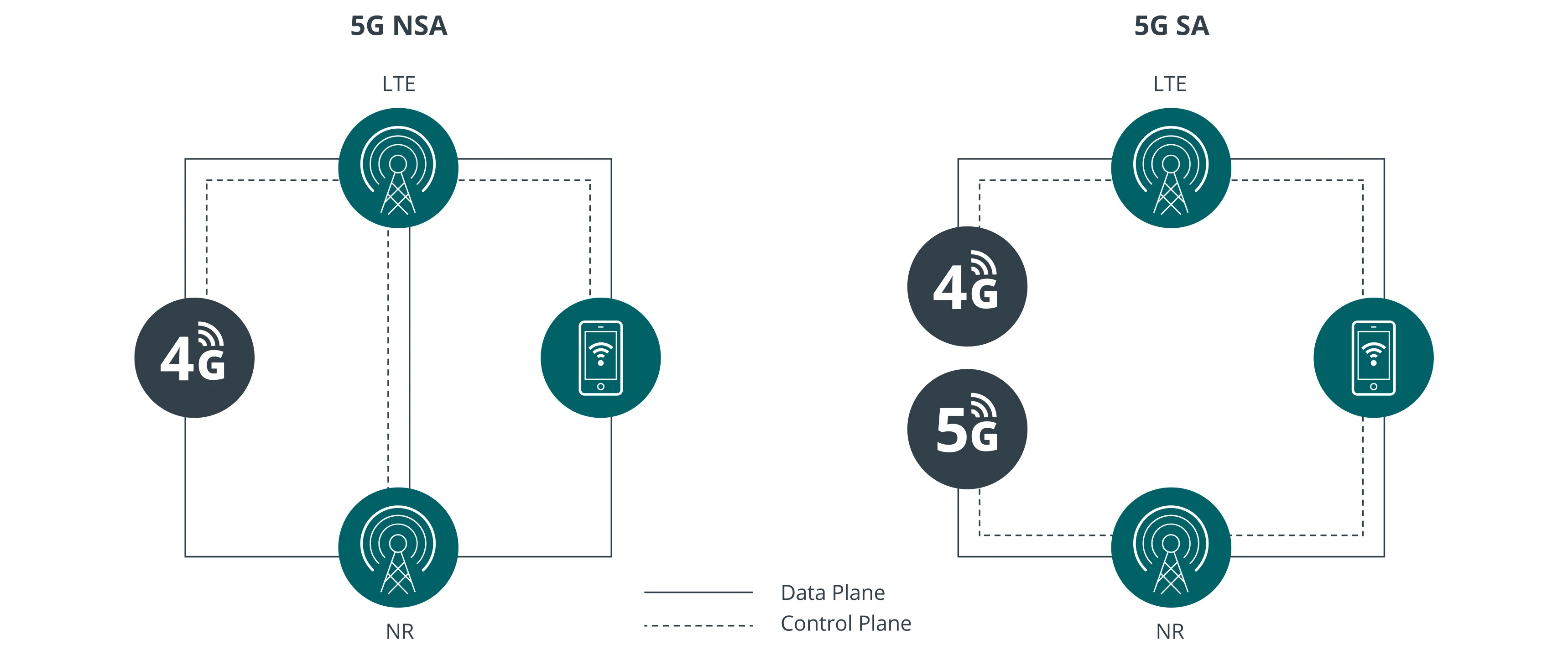
Key Differences Between 5G Non-Standalone (NSA) and 5G Standalone (SA) Architectures
From a network architecture perspective, NSA and SA models differ in the way that end devices connect to the core network and, more importantly, the type of core network to which they connect.
By connecting to the existing 4G core network infrastructure, 5G NSA networks enable higher data transfer speeds to support enhanced mobile broadband eMBB use cases and experiences. This deployment is achieved when 5G RAN's New Radio (NR) interface is added on top of the 4G LTE network.
As a result, and as the name suggests, the 5G radio cannot "stand" alone. In this type of deployment the 4G LTE macro cell base station is needed for control plane signaling (coverage) and call establishment while the 5G NR is only used to deliver high data rates/transfers.
In SA 5G networks, the 5G NR works independently and is deployed with dedicated 5G equipment and network functionalities. In this scenario, the network is directly linked to a cloud-native 5G core which can deliver a more complete experience including support for advanced use cases requiring ultra reliable low latency communications (uRLLC) and massive machine type communication (mMTC).
Why do operators choose 5G NSA?
For many operators, 5G NSA offers a logical and iterative first step when introducing of 5G services. As operators can leverage their existing 4G network infrastructure, this route accelerates commercial rollout with a reduced initial investment. And while 5G NSA has played a major part in the underpinning of nationwide 5G coverage, network latency and overall network efficiency remains limited.
Why do operators choose 5G (SA)?
Today, most service providers see 5G SA as the necessary end goal for 5G service evolution with a purpose-built architecture that, although more costly to deploy, can support more advanced and future-forward use cases.
Operating with an end-to-end 5G network (radio and core) for signaling and data, elapsed time between data requests and delivery is dramatically lowered enabling reliable, real-time responses for time-sensitive applications and seamless, uninterrupted mobile communications. 5G SA's ultra-low latency is complemented by a massive increase in available network capacity (bandwidth) making it the ideal architecture when serving businesses, industries, and municipalities. As a bonus, when connectivity is provided by a single technology, the overall power consumption is reduced.
Learn How NETSCOUT Can Help
NETSCOUT helps service providers assure 5G NSA and 5G SA performance with trusted 5G network performance monitoring and AI-ready operational intelligence. As networks become more dynamic, disaggregated, and software-driven, CSPs need high-quality, real-time data that reflects actual network behavior across 5G, RAN, core, cloud, edge, and transport environments. NETSCOUT’s Omnis Sensor and Omnis Streamer transforms packet-level network transactions into curated, AI-ready smart data that supports AIOps, NetOps, SecOps, automation, predictive maintenance, faster root-cause analysis, and improved subscriber experience. For RAN teams, Omnis Sensor RAN and Omnis Streamer RAN deliver contextual, vendor-independent RAN datasets that preserve subscriber, location, mobility, and causality insights to help operators plan, deploy, optimize, and automate 5G services with greater confidence.
By combining packet-based observability, deep packet inspection, and AI-curated datasets, NETSCOUT gives service providers the trusted operational foundation needed to move from reactive troubleshooting to intelligent, automated operations. That foundation is especially important as operators evolve from NSA coverage-driven deployments toward SA architectures that support network slicing, low-latency services, Fixed Wireless Access, enterprise SLAs, and future 5G-Advanced use cases.