

The Future of Observability Isn’t More Data; It’s Smarter Data
Context-rich data delivers better insights without exponential enterprise observability costs.


In a recent article on LinkedIn, “Observability Is the New Tech Debt Crisis,” I argued the case that CIOs can enhance their observability practices and reduce observability cost growth simultaneously. Enterprise IT teams still experience difficulties responding to outages and disruptions despite spending more and more on observability each year, creating this tech debt crisis. Overall, too many teams are trying to solve their observability challenges by gathering, and paying for, more of the same data instead of prioritizing having the right data to achieve ideal outcomes. And once that prioritization becomes the focus, they’ll stop hoarding more data and start seeing more impact.
IDC research shows that major enterprises are now spending from $1 million to $10 million on their observability practices annually, with more than $1 million often reserved for simply storing telemetry. But Gartner reports that despite all that spending, up to 84 percent of observability users struggle with the costs and complexity of their daily monitoring responsibilities. This presents a major opportunity for enterprises to rethink their approach to observability data, but where do they start?
The Cost of Scaling Data to Meet Enterprise Needs
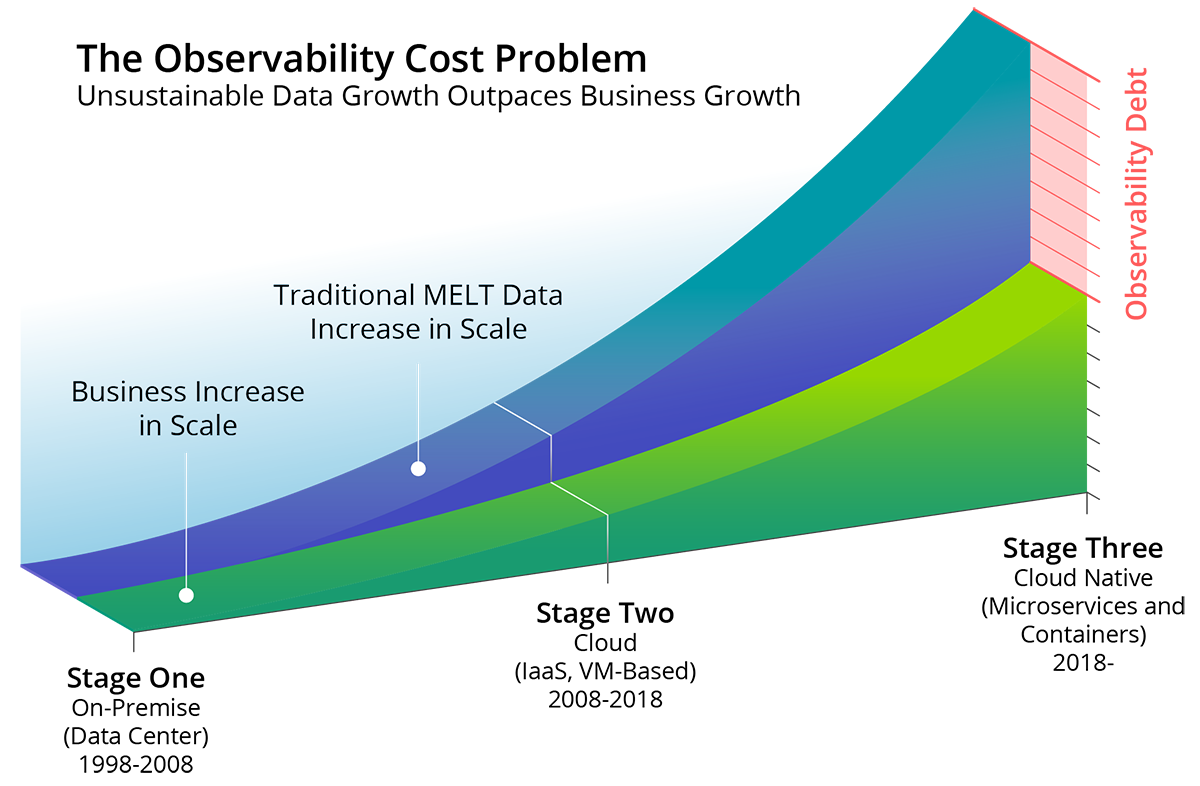
As systems grow exponentially in scale and complexity, teams allow observability costs to grow the same way.
They shouldn’t. And economically, they can’t.
Revenue doesn’t scale exponentially. Budgets don’t either. But observability bills do, because the industry keeps selling the same idea: that more data equals more insight. It’s not that simple.
The Missing Layer Is Smart Data
This gap is closed with NETSCOUT Smart Data. The IT teams drowning in traditional observability telemetry such as metrics, events, logs, and traces (MELT) are chasing better context. But the data they have has gaps: gaps in time, gaps in coverage, and gaps in detail. Smart Data provides the context that MELT data lacks, thanks to deep packet inspection. When used in combination, Smart Data and traditional MELT data come together to form MELT+, a new data foundation for observability, for which analysts such as IDC are beginning to recognize the need in their latest “Enterprise System Management Observability and AIOps Software” report.
Smart Data is produced by the NETSCOUT data platform. It leverages deep packet inspection (DPI) at scale to generate the data layer that gives organizations actionable insights and the context AI-driven operations need. Because Smart Data is derived from the network itself, it means that each new application doesn’t need new instrumentation. And with analytics conducted at the source of data capture and storage handled within the sensor itself, CIOs and their teams can get better observability and reduce their data costs.
NETSCOUT Smart Data delivers the data foundation for AI-powered observability solutions at enterprise scale. But Smart Data can also be used by a variety of different teams across the organization, including NetOps, SecOps, AIOps, observability teams, and more. This shared data source improves efficiency, increases the speed of root cause analysis, and reduces the costs of collecting different datasets for various use cases.
Here’s How We’ve Seen This Work Across Industries
We have seen this work across enterprises in varying industries. In the healthcare industry, Smart Data helped to ensure the network of a major healthcare organization serving tens of millions of patients across nearly a dozen states runs smoothly and efficiently, keeping vital applications such as EPIC, telemedicine services, ePharmacy, and patient portals available and performing optimally so that all parties involved have easy access to imperative healthcare information.
Renewable energy growth was a major priority for one of the largest electric utility providers in the United States, and Smart Data helped support key initiatives around solar, wind, and battery storage. Maintaining high-performance connectivity across this distributed operational technology (OT) ecosystem, including remote energy sites and substations, customer service platforms, and internal systems, helps this clean energy pioneer increase profitability and compliance thanks to real-time infrastructure insights powered by efficient data and end-to-end visibility.
When manufacturing lines grind to a halt, so does the business. Leveraging Smart Data to maintain uptime has saved a major manufacturer tens of millions of dollars per year, driving increased profits, maintaining employee productivity, and eliminating the need for large-scale war-room interventions that reduce the time taken to resolve issues.
Every enterprise is working toward the same destination: AI-driven digital operations that predict issues before they disrupt the business, automate routine decisions, and allow IT teams to spend less time searching for answers and more time improving outcomes. But AI won’t transform operations if it’s built on incomplete, sampled, or disconnected data. The future belongs to organizations that invest first in the quality of their operational data. Smart Data provides the AI-ready foundation to make that future possible.
Explore our observability solutions to see how Smart Data can help remedy your tech debt crisis.