Overview
Visibility Throughout the Airline Environment
Airline passenger volumes continue to surge, breaking aviation records year after year. As competition intensifies, airline leaders are prioritizing the passenger digital experience across the entire journey. While many external factors, from severe weather to understaffed control towers, remain outside their control, the digital infrastructure that is the foundation for their operations is one domain they can influence.
Airlines work relentlessly to deliver seamless digital experiences for passenger-facing services such as reservations, ticketing, loyalty programs, and baggage handling. Similarly, performance of crew management, flight planning, and maintenance scheduling is equally critical for the operational systems that keep the airline running as they directly affect revenue, cost efficiency, and brand reputation. Because airline and airport operations run on highly interconnected ecosystems, when any disruption occurs, the impact is immediate and far reaching. This complexity makes real-time, end-to-end observability essential to maintain service assurance and anticipate issues before passengers, crews, or operations are impacted.

Trusted by industry leaders worldwide


Challenges
Managing the Complexity of Airline Network and Application Environments
Costly, Reactive Troubleshooting in Downtime-Intolerant Operations
Unplanned downtime creates immediate financial and reputational risks to airlines. Groundings, system maintenance outages, and communications disruptions can cascade into multi-hour outages that increases passenger rebookings and erodes revenue.
Lack of End-to-End Visibility Across Hybrid Environments
As airline network complexity and digital dependency accelerates, gaps in end-to-end visibility hinder fast troubleshooting, prolong outages, and make problem isolation across today’s highly distributed airline and airport ecosystem difficult.
Expanded Attack Surfaces Increase Risks
Cyber-attacks increase security risks across airlines’ highly interconnected network environments. As operational systems increasingly connect to enterprise IT and hybrid / public cloud, new attack paths emerge, raising exposure and increasing operational risk.
Quality User Experience in Contact Centers
Distributed contact centers are critical to airline customer service. Without observability, user experience that degrades during reservation availability, ticketing, or travel-change calls can be difficult to troubleshoot in multi-vendor communications environments.
Costly Data Silos and Fragmented Observability
Telemetry often sits with separate operations and security teams, slowing investigation and extending resolution times. This fragmentation increases data retention costs while providing only partial observability into some network locations and for a subset of application services in use.
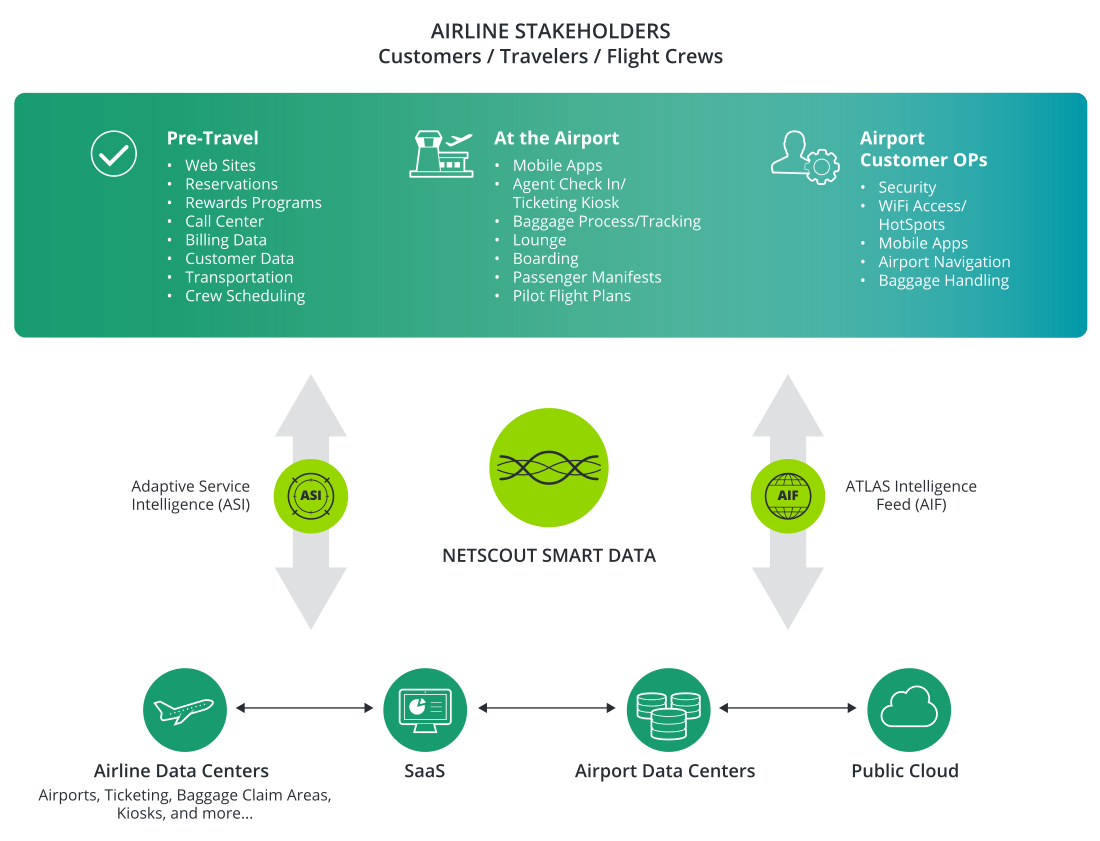
Outcomes That Matter
The Importance of Observability When Getting Passengers from Point A to Point B In a Timely Manner
Ensure Efficient Operation of Airline Applications
NETSCOUT supports more than 1,000 applications, ticket inventories and loyalty programs to crew management and passenger manifests. This in-depth visibility helps IT rapidly identify and resolve application-specific issues across the ecosystem.
Dramatically Lower MTTK and MTTR
Proactive, preventative monitoring pinpoints issues and locations fast, helping IT to proceed with actionable insights. This dramatically lowers mean time to knowledge (MTTK) and resolution (MTTR) while restoring performance across multi-vendor infrastructures from airports to customer call centers.
Protect Airline On-time Arrivals and Reduce Financial Damages from Cyber Incidents
Rapid detection and response across airline environments from NETSCOUT reduces the risk of DDoS attacks, lateral movement, prevents operational disruption, exfiltration of confidential data, and minimizes financial impact and regulatory fines.
Eliminate the Need for Expensive, Unproductive War Rooms
With a single, vendor-independent, enterprise-wide observability solution, uptime can be improved and operational risks reduced at airports, contact centers, data centers and cloud infrastructure. Deep packet inspection (DPI), as the single source of truth, yields quick results from IT team and vendor partner collaborations.
Protect and Extend the Value of Existing and Future Observability Investments
As airlines move ahead with AI, IoT, automation, and robotics, NETSCOUT future-proofs investments and optimizes ROI with network observability and security solutions that meet your needs today and in the future.
Use Cases
Observability and Security Insights for Airline Organizations
Airline organizations using NETSCOUT improve operational resilience, reduce risk, and help improve the success of their digital initiatives.


What Our Customers Are Saying
"NETSCOUT has more features, better visibility, and enhanced troubleshooting capabilities, which were factors that prompted my team to switch from our previous tool"
- Customer Success review on G2
Check out the reviews
Resources
FAQs
Frequently Asked Questions
What airline applications should be part of proactive observability processes?
Comprehensive monitoring and analysis, leveraging a network vantage point, provides critical insights into virtually all airline application activity, service dependencies, and the underlying network, including connectivity and traffic paths that impact performance, latency, errors, packet loss and much more. This is critically important for applications used in every area of airline operations, including Crew Management Systems, Computer Reservation Systems (CRS), Customer Relationship Management (CRM), Departure Control Systems (DCS), Baggage Handling Systems, and Maintenance, Repair & Overhaul (MRO) among others.
How Can NETSCOUT help with user experience and performance issues in airline ticket offices and contact centers?
NETSCOUT supports observability in any remote location the airline IT team needs to assure performance and security including ticket offices, airport locations, maintenance facilities, as well as contact centers. NETSCOUT’s nGenius solutions for observability deliver proactive monitoring for deep packet inspection (DPI) that enables IT organizations to move beyond reactive troubleshooting into more predictive and preventative postures, which is critical to the success of airlines and their passenger journeys.
How does NETSCOUT performance analysis of airline applications differ from competitors’ tools?
NETSCOUT’s patented ASI technology, or Smart Data, delivers IP intelligence and metadata derived from packets. It natively supports over a thousand applications “out of the box,” including airline applications used for both operations and that passenger travel journey, as well as provides flexible configuration options to support custom applications. NETSCOUT is the only solution to provide such flexibility.
How does NETSCOUT support Zero Trust and security in airline operations?
Security and Zero Trust initiatives are powered by NETSCOUT’s Omnis Cybersecurity solutions, including Omnis Cyber Intelligence and Omnis CyberStream, which provide packet-level insights for validating network segmentation, monitoring policy enforcement, and investigating suspicious activity. It gives airline organizations insights into real network behavior to identify lateral movement, exfiltration of confidential data, and control gaps across hybrid environments.
How does NETSCOUT protect the availability of airline operations?
NETSCOUT’s Arbor DDoS protection solution provides airline organizations with multilayer DDoS protection that stops attacks at the edge, scales in the cloud, and adapts in real time. By combining always-on, on-premises mitigation with cloud-scale capacity and AI-driven intelligence, NETSCOUT protects critical airline application and network services from all attack types and sizes.