

Troubleshooting SaaS/UCaaS/Cloud-Based Application Issues with Observability
Whose problem is it, anyway?


Software-as-a-service (SaaS), unified-communications-as-a-service (UCaaS), and cloud-based applications are an integral part of enterprise networks today for essential services that keep business operations running. However, when performance slows or a service goes down, finding the source of the problem can be anything but simple. IT teams must quickly determine whether the issue lies within their own environment, across the network, or with the third-party hosted application that they do not control.
Visibility gaps make issues with performance of critical services among the most difficult to troubleshoot and often result in lengthy, headline-making, customer-impacting disruptions. It is imperative that SaaS, UCaaS, and cloud-based applications be a strategic part of today’s comprehensive, end-to-end observability strategies to protect customer digital experience, employee productivity, revenue, costs, regulatory compliance, and reputation.
Real-World Application Outages Impacting Customers
Consider three separate outages that occurred in the last year.
- SaaS application: Customers were experiencing login failures and inability to access their SaaS accounts. Following a five-and-a-half-hour outage, the company identified a recent networking patch as a possible trigger and began remediation to restore services. The company also called out a monitoring gap in its environment that contributed to the lengthy resolution time.
“The technology team identified a monitoring gap as a contributing factor to the prolonged impact period… The technology team is enhancing the monitoring and expanding the alerting thresholds so similar issues can be detected more quickly in the future.”
- UCaaS application: Customers interacting with a contact center using a UCaaS application were experiencing intermittent silent/one-way audio conditions. Although the provider quickly focused on users of Microsoft Teams, it took more than 48 hours to pinpoint a codec negotiation and application interoperability problem. Once a codec rollback was performed, two-way audio was restored for customers.
- Cloud-based application: Users of a number of cloud-based applications were experiencing connection timeouts and drops, service unavailability, packet loss, and API timeouts. Users’ connections to their applications and services were restored following four hours of troubleshooting. The cloud provider identified a scheduled capacity upgrade in the data center routers that had not followed corporate processes for causing the customers’ service disruption in connecting to their virtual machines.
Together, these three incidents illustrate how outages affect customers and employees—and how limited observability can prolong disruptions.
It’s a Well-Known Problem: Troubleshooting SaaS, UCaaS, and Cloud Services
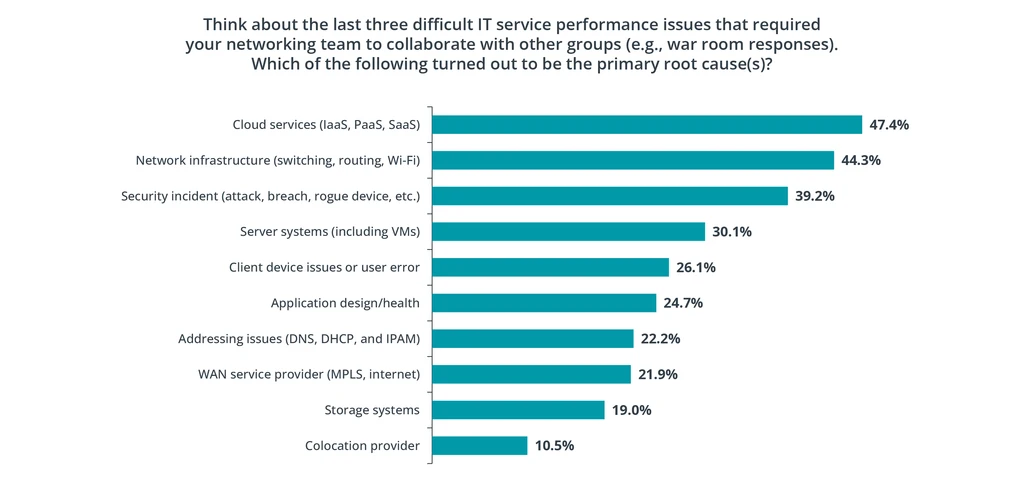
The challenges in troubleshooting SaaS, UCaaS, and cloud services has been well documented in recent years. Most recently, NETSCOUT’s EMA “Network Management Megatrends 2026 Study,” based on a survey of more than 350 IT professionals and one-on-one interviews with senior networking experts in Global 2000 companies across North America and Europe, highlighted the issue. The respondents identified the No. 1 issue that required their networking team to collaborate with other groups, such as in a war room, was ultimately determined to be due to a cloud services root cause.
The Enterprise IT Perspective
The incidents highlighted above are examples of problems enterprises experience. Their IT teams took employee help desk calls as the problems started, and the teams determined the need to collaborate with their vendors to investigate and pinpoint the problems. In all three cases, root cause was isolated to the vendor environment.
The EMA study results make it clear that nearly half of the respondents need multiple people to pinpoint the root cause, which isn’t always a vendor. The complexity of today’s enterprise environments means when a problem occurs, any number of points across the communications path could be contributing to the issue. This is why many enterprises struggle with protracted, and unnecessarily lengthy, service disruptions as the IT teams and vendors collectively troubleshoot the issue.
The Value of Vendor-Independent Observability
NETSCOUT’s vendor-independent approach to observability, particularly in today’s complex SaaS, UCaaS, and cloud-based application services environments, can make a dramatic difference in proactive visibility, early warning indicators, and rapid root cause analysis. NETSCOUT solutions for observability provide insight into how SaaS, UCaaS, and cloud-based applications truly perform for users, helping teams get answers faster and improve outcomes.
Leveraging deep packet inspection (DPI) at scale and Adaptive Service Intelligence (ASI), NETSCOUT AI-ready Smart Data provides network evidence to share among IT teams and vendor partners. Comprehensive monitoring combines synthetic testing, from wherever your employees access SaaS, UCaaS, and cloud-based services, for visibility into user experience, application performance, and network health. Armed with this information, organizations can identify emerging issues, pinpoint root causes, and resolve them early, proactively, and efficiently, leveraging NETSCOUT solutions for observability.
For more information on how NETSCOUT assures performance of SaaS, UCaaS, and cloud-based services with nGenius solutions for observability, visit our application performance management page and nGeniusONE page.