

Observability with AI-Ready Data Helps Reduce Time to Solve Problems
Recent insights from NETSCOUT’s survey of 950 attendees at Cisco Live 2026


For years, enterprises have invested in technologies to improve networking, communications, competitiveness, costs, and productivity. Yet many have not kept pace with the monitoring tools, observability platforms, automation, and AI-driven solutions needed to gain deeper operational visibility. Without it, IT teams remain stuck in reactive, time-consuming troubleshooting instead of moving toward proactive, predictive problem resolution.
Recent findings from the NETSCOUT Cisco Live 2026 survey of 950 attendees suggest the challenge is not simply a lack of data. It is a lack of actionable visibility across increasingly complex environments. The result? Longer troubleshooting cycles, greater business impact, and mounting pressure on IT teams tasked with keeping critical services running.
The MTTR Problem Is Getting Worse
One of the most revealing findings from this year’s survey centers on mean time to resolution (MTTR). Only 11 percent of respondents reported resolving issues within a few minutes. Over half (56.2 percent) required a few hours, while more than 1 in 4 organizations (28.7 percent) needed a day to several days. Compared with 2025, when nearly 17 percent resolved performance problems within minutes and 64 percent resolved issues within a few hours, the trend is alarming (see Figure 1).
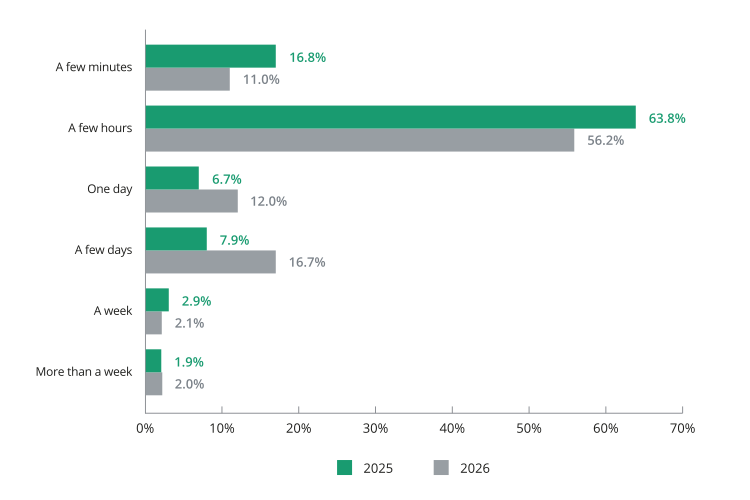
Figure 1: Comparing 2025 and 2026 performance issue resolution time
In 2025, 81 percent of participants could address issues within a few hours or less. This year, that dropped to 67 percent. At the same time, cases requiring a day to a week nearly doubled, from 14.6 percent to 28.7 percent. Clearly, troubleshooting and problem resolution are taking longer. By extension, risks to user quality, performance, productivity, revenue, costs, and corporate reputation increase as outages and disruptions expand.
Complexity Is Outpacing Visibility
Today’s enterprises operate in environments that barely resemble the traditional data center architectures of a decade ago. Consider some of today’s challenges:
- Applications now span multiple clouds.
- Critical business services depend on software-as-a-service (SaaS) providers.
- Kubernetes clusters dynamically spin up and down resources.
- AI workloads introduce new traffic patterns and infrastructure demands.
- Employees work from anywhere.
Each transformation initiative delivers business value while introducing new layers of complexity. Yet visibility often fails to evolve at the same pace. Many organizations still rely on point tools designed for legacy, static environments. As workloads move across cloud platforms, containers, remote sites, and hybrid infrastructures, visibility gaps emerge.
When an issue occurs, engineers must piece together evidence from disconnected tools, dashboards, and telemetry sources. The result is familiar: more alerts, more data, and longer troubleshooting cycles. Improving MTTR requires better evidence, not additional monitoring tools.
More Data Doesn’t Always Mean Better Answers
A common observability assumption is that more telemetry automatically produces better outcomes. The survey results are more nuanced. Metrics, events, logs, and traces (MELT) telemetry was the most common source of observability data at 39.5 percent. Network-derived intelligence also remains significant: Packet capture accounted for 21.6 percent, flow data 18.8 percent, and deep packet inspection (DPI) 9.7 percent (see Figure 2).
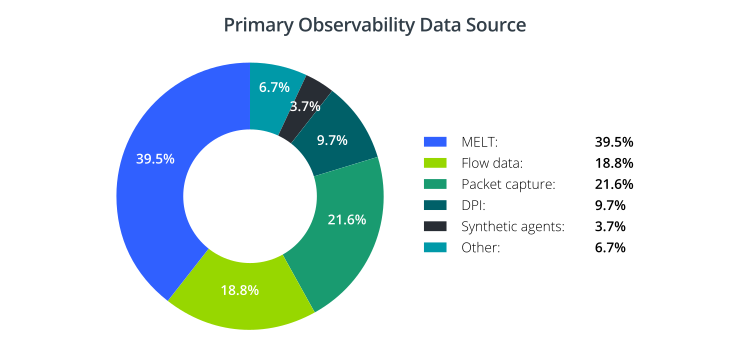
Figure 2: Primary observability data sources
The insight is clear: Organizations increasingly rely on multiple forms of telemetry to meet visibility objectives. Metrics may indicate that a problem exists, logs may record an event, and traces may show where latency occurs. But network-derived telemetry provides context that helps validate assumptions and accelerate investigations. Without it, teams may spend valuable time chasing symptoms rather than identifying root causes.
The DPI Gap
Comparing observability practices to priorities reveals an interesting point. Although only 9.7 percent of organizations identify DPI as their primary source of observability data, nearly two-thirds (64.3 percent) said DPI was important or very important to their observability strategy (see Figure 3).
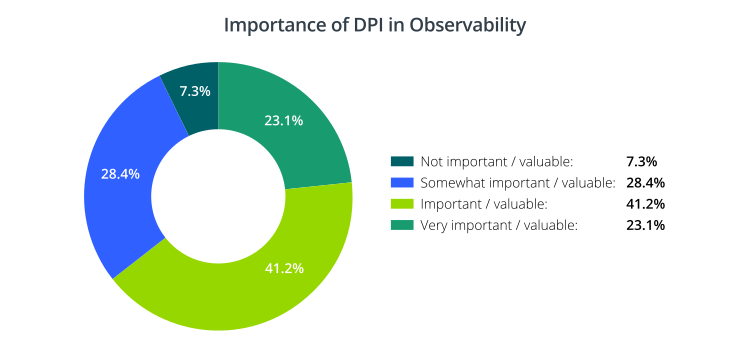
Figure 3: Importance of DPI in observability
At first glance, these results appear contradictory. If DPI is so valuable, why isn’t it more widely used? The answer may lie in today’s operational realities. Many organizations recognize the value of packet-level evidence because it provides direct visibility into application and network behavior, performance, user experience, and more.
Unlike sampled data or inferred conclusions, packet intelligence offers concrete details and metrics related to the activity of users, applications, and services. Operations teams understand the value of DPI but lack consistent access to it during investigations. This creates a gap between what they need from observability and the visibility they actually possess.
NETSCOUT Helps Transform IT from Reactive Troubleshooting to Predictive Operations
The survey findings highlight an important issue facing enterprises. Outages are taking longer to be resolved, and that is unacceptable. Overcoming lengthy service restoration times is not simply about collecting more data to sift through. It is about collecting the right data to accelerate troubleshooting and restore services faster. As digital environments become more distributed and complex, organizations need observability strategies that provide end-to-end visibility across applications, infrastructure, cloud services, and networks. That visibility must be vendor-independent, comprehensive, and grounded in high-fidelity evidence.
NETSCOUT Smart Data provides rich analysis from DPI and packet-based observability that delivers the critical foundation necessary to achieve meaningful reductions in MTTR. NETSCOUT solutions reveal what is actually happening across the environment as opposed to what individual tools infer might be happening. This intelligence provides actionable insights to help organizations move beyond reactive firefighting to achieve more proactive, predictive, and ultimately preventive operations.
The payoff is significant: faster root-cause analysis, accelerated MTTR, reduced operational costs, and fewer disruptions to employee productivity, customer experience, and revenue-generating services. Because in today’s digital enterprise, the fastest way to solve a problem is to see it clearly in the first place.
Learn more from the insights revealed by IT staff attending Cisco Live 2026.