


Restricted Substances
NETSCOUT ensures that our products comply with all applicable requirements related to restricted and hazardous substances, including the following:
- RoHS Directive
- The revised EU RoHS Directive 2011/65/EU was published in the Official Journal of the European Union on January 7, 2011. Although it is also considered a “recast” Directive, it is more commonly known as the “RoHS II Directive”. RoHS bans the use of certain hazardous substances (such as lead, mercury, cadmium, hexavalent chromium and some polybrominated flame retardants) in electrical and electronic equipment (EEE).
- NETSCOUT products placed on the market in the EU do not contain any of the restricted substances in concentrations and applications not permitted by the RoHS II Directive.
- WEEE Directive
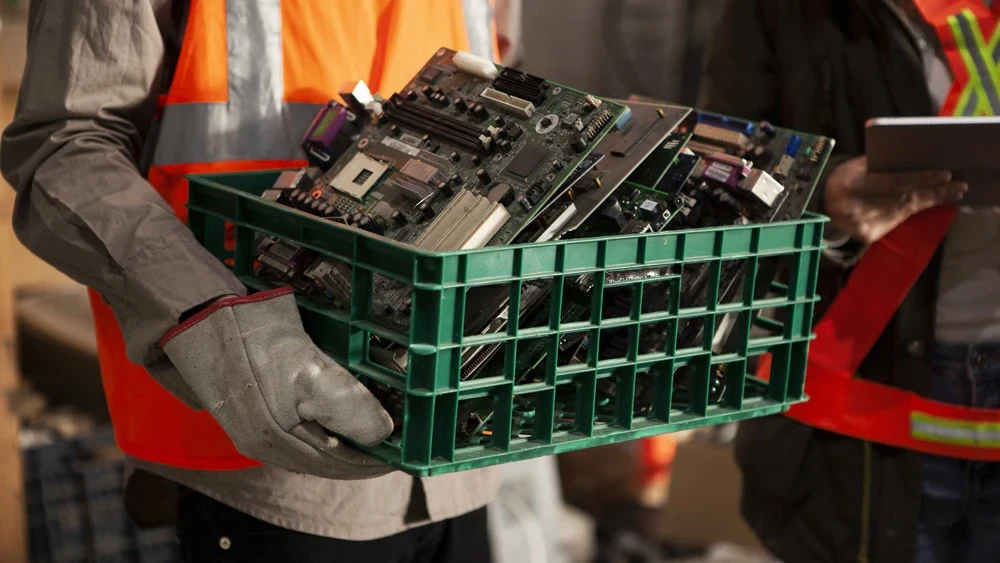
- The revised WEEE Directive was published in the Official Journal of the European Union on July 24, 2012. The new legislation is often called the “WEEE Recast Directive”. WEEE sets out the financial and other responsibilities of EEE producers regarding the collection and recycling of waste from a broad range of EEE at their end of life.
- Take back and recycling services are offered for NETSCOUT products in certain countries. If you have purchased NETSCOUT products in the EU after August 13, 2005 and are intending to discard these products at the end of their useful life, please do not dispose of them with your other household or municipal waste. We’ve labeled our products with the WEEE label (crossed-out wheelie bin symbol) to alert our customers that products bearing this label should not be disposed of in a landfill or with municipal or household waste in the EU. Instead, please be aware that we’ve developed a take-back program for proper disposal of NETSCOUT products at reputable recycling centers.
- If your product has the crossed-out wheelie bin symbol, it may be covered under a program that allows you to return the waste product to us for proper treatment, recovery, and disposal. Please check the terms of your end-user license agreement (sent with the product) to see whether you are eligible for our take-back program. The NETSCOUT take-back program applies to all products sold to European Union (EU) Member States. All returned NETSCOUT products must have a Returned Material Authorization (RMA) number assigned.
- If you are not located in any of the European Union countries, or if you purchased the product prior to August 13, 2005, you are still responsible for the proper disposal of the product through a reputable, licensed hazardous materials processor.
- For instructions on how to receive an RMA number and return your waste electrical product to NETSCOUT for treatment and proper disposal, please email quality@NETSCOUT.com.
- REACH – EU Regulation (EC) No 1907/2006 concerning the Registration, Evaluation, Authorization and Restriction of Chemicals (REACH), 18 December 2008, which requires industry to be responsible for the safe manufacture and use of chemicals and aims to ensure that sufficient information is communicated down the supply chain to allow the safe use of articles.
- China RoHS – Legislation entitled “Management Methods for the Restriction of the Use of Hazardous Substances in Electrical and Electronic Products,” published by China’s Ministry of Industry and Information Technology (“MIIT”) on January 21, 2016, which establishes content limit restrictions for six substances and establishes related labeling requirements.
- EU Battery Directive – Directive 2006/66/EC on batteries and accumulators and waste batteries and accumulators, or the EU Battery Directive, has the aim of minimizing the negative impact of batteries on the environment and improving their overall environmental performance. It restricts the use of some materials in batteries (particularly mercury and cadmium) and tasks Member States with encouraging the development of improvements to the environmental performance of batteries and putting in place battery collection schemes.
- EU Packaging Directive – The Packaging and Packaging Waste Directive 2004/12/EC (PPWD) places requirements on companies selling packaging and packaged goods in Europe.
- State of California (USA) Proposition 65 – In 1986, California voters approved an initiative to address their growing concerns about exposure to toxic chemicals. That initiative became the Safe Drinking Water and Toxic Enforcement Act of 1986, better known by its original name of Proposition 65. Proposition 65 requires the State to publish a list of chemicals known to cause cancer or birth defects or other reproductive harm. This list, which must be updated at least once a year, has grown to include approximately 800 chemicals since it was first published in 1987. Proposition 65 requires businesses to notify Californians about significant amounts of chemicals in the products they purchase, in their homes or workplaces, or that are released into the environment.