

Does It Feel Like a Stormy Season in Your Cloud?
Proactive observability in Kubernetes environments


How successful do IT teams feel they are at managing networking and security in the public cloud? Just over a third (36 percent) of IT professionals surveyed think their organization is completely successful in these environments. In reporting this finding, Enterprise Management Association (EMA) shared the top challenges reported by the respondents in its “Network Management Megatrends 2026” report:
- Complexity of cloud-native networking constructs
- Skills gaps on the network team
- Limited end-to-end visibility across on-premises and cloud networks
These are critical concerns for any IT organization and are worth exploring further as observability strategies and tool consolidations become possible focal points for many companies in the next couple of years.
NetOps Success and Tool Satisfaction Lag
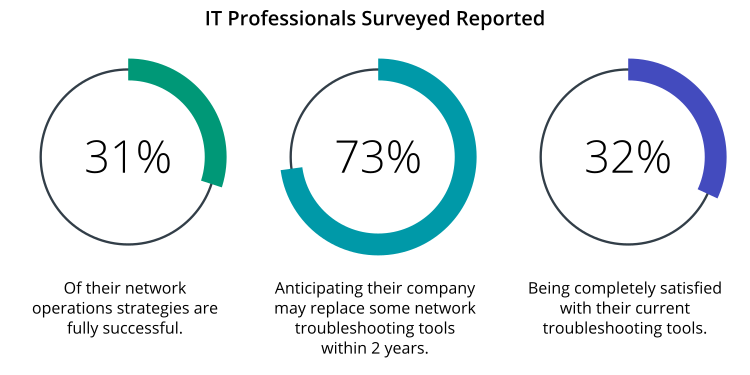
Research from EMA’s “Network Management Megatrends 2026” study suggests network operations (NetOps) teams see room for improvement in their company’s strategy execution and in the toolsets they rely on every day. Only 31 percent of responding IT professionals said their network operations strategies are fully successful, and just 32 percent reported being completely satisfied with their current troubleshooting tools. That dissatisfaction may propel action: 73 percent anticipate their organization may replace some network troubleshooting tools within the next two years.
The study also sheds light on where those gaps in observability create the biggest operational loss. When respondents were asked what most often triggers a major “war room” collaboration to resolve a service performance issue, the top answer was cloud service models, such as infrastructure as a service (IaaS), platform as a service (PaaS), and software as a service (SaaS). Consistent with that, public cloud (IaaS, PaaS) was also identified as the most challenging network domain to monitor and manage with existing tools. Containers/Kubernetes landed among the top five challenges overall.
The Rise in Kubernetes Use
Kubernetes is now the default choice for building scalable, observable systems, with 82 percent of container users deploying Kubernetes in production, according to a January 2026 announcement from the Cloud Native Computing Foundation. This was a significant increase from 66 percent in 2023.
The global Kubernetes market was valued at $2.11 billion in 2024, grew to $2.61 billion in 2025, and is expected to reach $14.6 billion by 2033: a staggering 24 percent compound annual growth rate (CAGR) from 2026 to 2033.
This growth makes sense, given Kubernetes offers flexibility and scale across private data centers, public cloud, or hybrid environments for both enterprises and service provider operations. However, as organizations add more production traffic through clusters, the network model becomes more dynamic, and that complexity can quickly outpace traditional monitoring approaches.
The Importance of Observability in Kubernetes Environments
Legacy monitoring tools often struggle in dynamic Kubernetes environments, where workloads are ephemeral, services are distributed, and connectivity spans clusters and clouds. That’s why modern observability has become so critical. It is proactive and context-aware, so operations teams can detect issues earlier, correlate symptoms across layers, and get to the root cause faster.
Performance Use Cases for Kubernetes: Enterprise
The following are Kubernetes-related performance and availability use cases in enterprise and service provider environments.
Many enterprises maintain private data center networks that support both legacy systems and cloud deployments. Hybrid workloads often operate in private cloud environments where Kubernetes coexists with virtual machines and bare-metal servers. In these settings, observability must provide the same rich insights into legacy and private cloud data center technologies, regardless of the technology deployed, be it Red Hat OpenShift Container Platform, OKD, or OSS vanilla Kubernetes.
Enterprises with public cloud deployments must contend with multiregional clusters and different managed services, such as AWS Elastic Kubernetes Service (EKS), Microsoft Azure Kubernetes Service (AKS), and Google Kubernetes Engine (GKE). And observability solutions must adapt to cloud-native APIs and services.
In both private and public cloud environments, observability solutions should:
- Correlate Kubernetes events with network events
- Map service dependencies
- Detect security threats, such as lateral movement or data exfiltration
- Enable automated troubleshooting and alerting
Enterprises often find observability in their Kubernetes environment particularly useful for visibility and control in networking, service discovery, and workload management. It helps:
- Developers deploying new services for alerting on regressions or misconfigurations of applications early in the lifecycle
- Development and operations (DevOps) for application performance tuning and service-level agreement (SLA) delivery
- NetOps for visibility to quickly identify, pinpoint, and resolve issues such as slow services, failed requests, or misconfigurations
Kubernetes Use Cases: Service Provider
In the case of service providers, whose scale and multitenancy environments differ from enterprises, Kubernetes observability is essential and helps:
- Monitor per-tenant traffic patterns
- Isolate faults quickly
- Enforce security and quality-of-service (QoS) policies dynamically
Does the Data Source Matter When It Comes to Observability?
EMA’s “Cloud Network Traffic Data” report revealed that packet data will play a critical role in both network and security operations over the next several years. It also indicated that there are challenges to collecting and analyzing packet data in the public cloud, including security risk, traffic encryption, and data quality.
Kubernetes networking is by nature dynamic. Pods are short-lived; IPs change constantly; and service-to-service communication can involve overlay networks, service meshes, and east-west traffic across clusters. Legacy tools are unlikely to be effective in this environment.
However, packet-based observability overcomes these characteristics with its ability to look at every packet sent across the environment. Every Domain Name System (DNS) lookup, Transport Layer Security (TLS) handshake, dropped packet, or application microburst is visible—because it’s in the packets. With full packet monitoring and analysis, leveraging deep packet inspection (DPI) at scale, operations teams gain:
- Protocol-level visibility (not just L3/L4, but deep into HTTP, gRPC, DNS, and so forth)
- Application performance insights, including retries, time-outs, and slow responses
- Real-time security detection, such as lateral movement, exfiltration, policy violations, or distributed denial-of-service (DDoS) activity
- Troubleshooting analysis including alerting, key performance indicators, error details, latency/jitter, and misconfigurations
NETSCOUT Recommendations
In private or public cloud environments, where observability has been a challenge, packets offer unmatched fidelity, accuracy, and context. Regardless of whether the requirement is for visibility in a single enterprise cluster or a multitenant platform serving thousands of customers, DPI-based observability delivers the real-time insight essential to optimize performance, reduce mean time to repair (MTTR), and enforce zero-trust policies.
Learn how NETSCOUT is overcoming the cloud visibility gap with the Omnis KlearSight Sensor for Kubernetes.