

Game-Changing AI in the RAN Plays by Its Own Rules
New report champions a practical and integrative approach for AI-driven efficiency and automation.


If you believe the hype, AI is on the verge of “taking over” the radio-access network (RAN), yet a new report from Senza Fili reveals the situation is far less dramatic.
In “Is AI taking over the RAN?,” Senza Fili Principal Analyst Monica Paolini suggests that AI is not replacing the RAN but rather exposing the limits of how service providers manage their networks today and how they will confront what comes next.
The Real Story Isn’t About AI
For the record, the telecom industry didn’t suddenly discover AI out of curiosity. Instead, AI was born out of necessity when networks reached levels of complexity that traditional operational models could no longer address. With more layers, more spectrum, more devices, more expectations, and flattening revenues, the economics simply won’t work without RAN automation.
And although the industry continues to promote an “AI in the RAN” story, the real goal is to run better, more efficient, more adaptive networks. Implementing AI isn’t the destination; it’s the path that will get us there.
Treat AI as a Strategy, Not as a Feature
In the report, Paolini highlights the reality of AI’s infancy as a counter to marketing hype, pointing out that AI deployments in the RAN remain narrow and task-specific, with the focus on things such as anomaly detection, energy optimization, and traffic management.
And while this is the deployment reality, many organizations are still approaching AI as something to “add” to the network, rather than something that fundamentally changes how the network operates.
As Paolini describes it, AI doesn’t just make existing processes faster; it changes the nature of those processes. AI surfaces patterns humans can’t see. It makes decisions in real time. It rewrites the boundaries of what’s operationally possible in RAN and 5G service assurance.
As a result, If the strategy is just to bolt AI onto legacy workflows, the return will always be limited.
A Trade-off No One Likes to Talk About
The caveat to advancement with AI is that the same technology that simplifies operations also makes things more complex.
AI-driven networks are more dynamic. They adapt in real time. They optimize continuously. But that also means they generate more changes, more interactions, and more opportunities for things to go wrong. Service providers can quickly find themselves replacing predictability with probabilistic behavior. And, while AI can reduce human error, it can also introduce new types of risk that have to be managed:
- Opaque decision-making
- Model bias
- Cascading failures
Without some level of accountability, autonomy is a nonstarter.
Industry Needs to Slow Down to Make Progress
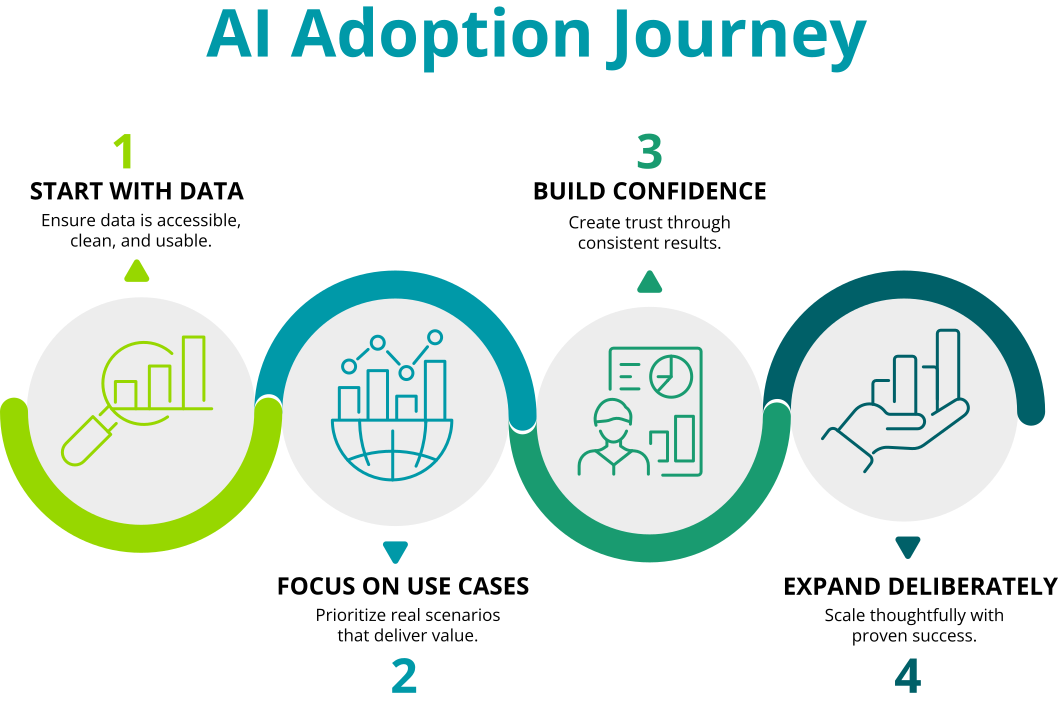
Although there is a growing sense of urgency around “AI-native RAN,” this report argues instead for a gradual, layered integration of AI that aligns with real operational needs and delivers measurable return on investment (ROI).
Choosing ROI Over Revenue Streams
Another area where reality diverges from the popular narrative is monetization.
For years, telecom has chased the idea that new technology layers (4G, 5G, and now AI) will unlock entirely new revenue streams. And yet, the results have been mixed.
In this report, a more grounded view is presented. AI’s most immediate and reliable impact is cost efficiency, not new revenue.
Reducing operational complexity, improving resource utilization, and avoiding unnecessary capital investments are tangible, controllable outcomes and a stronger foundation for long-term transformation.
The Future Is AI-Integrated
Eventually, we may in fact realize a fully AI-native RAN. But that future is tied to much longer technology cycles:
- 6G timelines
- New silicon architecture
- Significant infrastructure refreshes
Instead, today’s AI should be layered into the RAN, one use case at a time, for bolt-on solutions, incremental wins, and more gradual change.
Success will not be measured by the operators with the “most AI,” but rather by the ones that integrate it most effectively across operations, processes, and decision-making.
Conclusion
While AI is not taking over the RAN, it is taking away our ability to ignore the fundamental challenges we’ve been managing for years:
- Complexity
- Inefficiency
- Unsustainable operating models
The reality is AI isn’t the story at all but rather the catalyst.
The real question isn’t whether AI will transform the RAN. It’s whether the industry is ready to transform itself in the process.
If you’re thinking about where to start with AI or how to course-correct an existing implementation, this is exactly the conversation you need to be having.
Read the full report to unpack practical steps, evaluate the trade-offs, and explore strategic decisions shaping AI adoption in the RAN today.