

Four AI Trends Transforming Network Operations
How AI amplifies operational expertise for strategic decision-making and accelerated root-cause analysis


The old way used to be all about observability, dashboards, aggregated KPIs, human correlation, and manual intervention. That world is changing with AI.
— Donogh O’Reilly, Vice President of Sales for NETSCOUT
Artificial intelligence (AI) no longer sits on the fringe of the service provider’s transformation strategy. It now resides squarely in the center of operational conversations and is reshaping how operators think about scale, resilience, and protecting the customer experience. In an era defined by distributed architectures, mission‑critical services, and rising digital expectations, AI is not simply evolving service assurance—it is redefining it.
For years, service providers leaned on dashboards, key performance indicators (KPIs), and skilled engineers to interpret what was happening inside their networks. And, that model served telcos well when networks were simpler.
Today’s environment is infinitely more complex. Multicloud traffic patterns, 5G‑enabled applications, Internet of Things (IoT) ecosystems, and data volumes that grow by the hour have fundamentally altered the operational landscape. Human-led correlation alone can no longer keep pace.
In a recent interview with FNTV, Donogh O’Reilly, vice president of Sales for NETSCOUT, discussed some of the emerging AI trends reshaping the industry.
Four Trends Transforming Network Operations
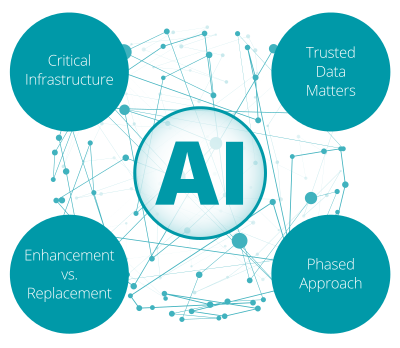
1. AI Is Now Critical Infrastructure
Let’s be clear, AI is no longer optional. Modern networks generate more signals, dependencies, and simultaneous service requirements than any human team can interpret in real time. AI fills that gap, processing vast telemetry streams, identifying patterns invisible to the human eye, and surfacing early signs of degradation before users ever notice.
This is no longer “future thinking.” It’s the operational backbone required to maintain reliability at scale.
Service providers who treat AI as a luxury will find themselves constrained not by competition, but by their own networks.
2. Trusted Data Will Make or Break AI
The industry’s first wave of AI experiments delivered a critical lesson: AI cannot rise above the quality of its data.
When fed inconsistent, incomplete, or “noisy” information, AI generates insights that are equally unpredictable. False positives increase. Trust erodes. Operational risk rises.
As Donogh emphasized, dependable AI begins with trusted, contextual, interrogable data grounded in real network traffic and behaviors. When that foundation is solid, AI becomes a force multiplier. When it’s not, it becomes a high-risk liability.
To succeed, service providers require:
- High‑fidelity, packet‑level visibility
- Data structures that preserve context
- Analytics grounded in network truth, not correlation guesses
Trusted data is what elevates AI from experimentation to an operational advantage.
3. AI is Enhancing Human Expertise, Not Replacing It
Automation anxiety is real although largely misplaced. AI is not here to take over network operations teams. It is here to unburden them. For years, operators have been the first and final lines of defense against outages, viewing multiple dashboards, comparing call logs, and making judgment calls under pressure. AI changes the starting point.
Instead of beginning with raw data, teams begin with context.
This shift allows operators to:
- Respond faster and more confidently
- Devote energy to strategic improvements rather than manual noise filtering
- Accelerate root‑cause analysis through AI‑driven correlations
AI doesn’t diminish expertise. It amplifies it—ensuring human skill is applied precisely where it creates the most impact.
4. Autonomous Networks Will Arrive in Phases, Although the Road to Success is Steep
Talk of autonomous networks often triggers questions about timing and feasibility. But autonomy isn’t an overnight cut-over. Although already in motion, it’s likely to be a gradual evolution.
For companies such as NETSCOUT, the framework for success outlines a four‑stage evolution toward autonomy, from insight enhancement to conditional autonomy.
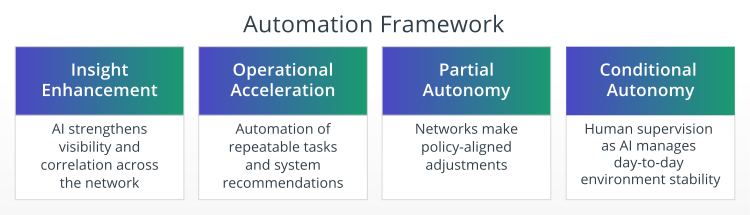
In highly distributed, mission‑critical telecom environments, a phased approach isn’t just practical but rather, necessary. Autonomy isn’t about reducing human control. It’s about scaling it.
The Strategic Imperative for Service Providers
As the trends suggest, AI is redefining what “good” looks like in service assurance. Providers that embrace grounded, contextual AI will strengthen performance, respond to issues faster, and deliver the seamless experiences customers now expect. Those who hesitate won’t just fall behind; they’ll fall out of alignment.
AI is not replacing the fundamentals of service assurance; it’s reinforcing them by adding the intelligence and speed required for today’s digital ecosystem.
How NETSCOUT Is Helping Service Providers Turn AI into Operational Reality
NETSCOUT gives service providers what the industry has long been missing: a foundation of trusted, high‑fidelity network data. By anchoring AI analytics in packet‑level visibility, we ensure insights are accurate, contextual, and immediately actionable, avoiding the theoretical and reducing the error‑prone.
This approach reduces operational noise, strengthens decision‑making, accelerates root‑cause analysis, and supports the step‑by‑step journey toward autonomous networks while ensuring that operators remain firmly in control.
Afterall, at the end of the day, the future of service assurance is not AI versus humans. Instead, it’s AI empowering humans to run networks more intelligently, more confidently, and more resiliently than ever before.
For more information about how NETSCOUT is helping service providers reach the milestones of autonomous networks, watch the entire interview.