

The 5G SA Visibility Problem
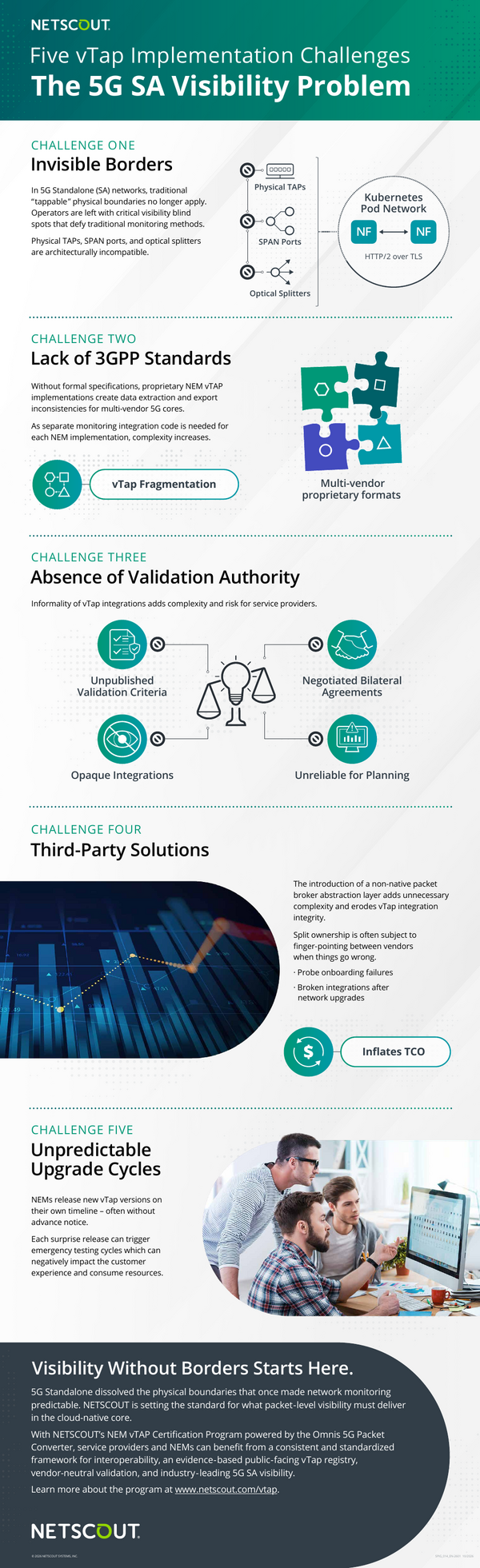
Service providers can learn why 5G standalone (SA) networks create monitoring blind spots and the five challenges that arise when virtual taps (vTAPs) replace physical access points. The infographic also describes NETSCOUT's NEM vTAP Certification Program, powered by the Omnis 5G Packet Converter.
Why is 5G SA visibility a problem?
In 5G SA networks, traditional tappable physical boundaries no longer apply, which leaves critical visibility blind spots. Physical TAPs, SPAN ports, and optical splitters are architecturally incompatible with the cloud-native core, where traffic runs as HTTP/2 over TLS inside Kubernetes pod networks.
What are the five vTAP implementation challenges?
The infographic names five challenges:
• Invisible borders from the loss of physical network boundaries
• Informal vTAP integrations, with proprietary network equipment manufacturer (NEM) implementations and no 3GPP standard
• Absence of a validation authority, with unpublished criteria and opaque integrations
• Third-party solutions, where a non-native packet broker layer adds complexity
• Unpredictable upgrade cycles, as NEMs release vTAP versions without advance notice
What does the NEM vTAP Certification Program offer?
The program gives service providers and NEMs a consistent, standardized framework for interoperability, an evidence-based public vTAP registry, and vendor-neutral validation.
Frequently Asked Questions
What problems do surprise vTAP releases cause?
They can trigger emergency testing cycles that affect the customer experience and consume resources.
Where can readers learn more about the program?
The infographic points to netscout.com/vtap.
Asset Type: Infographic