DDoS Threat Intelligence Report: Attacks on Demand (Issue 17, 1H 2026)
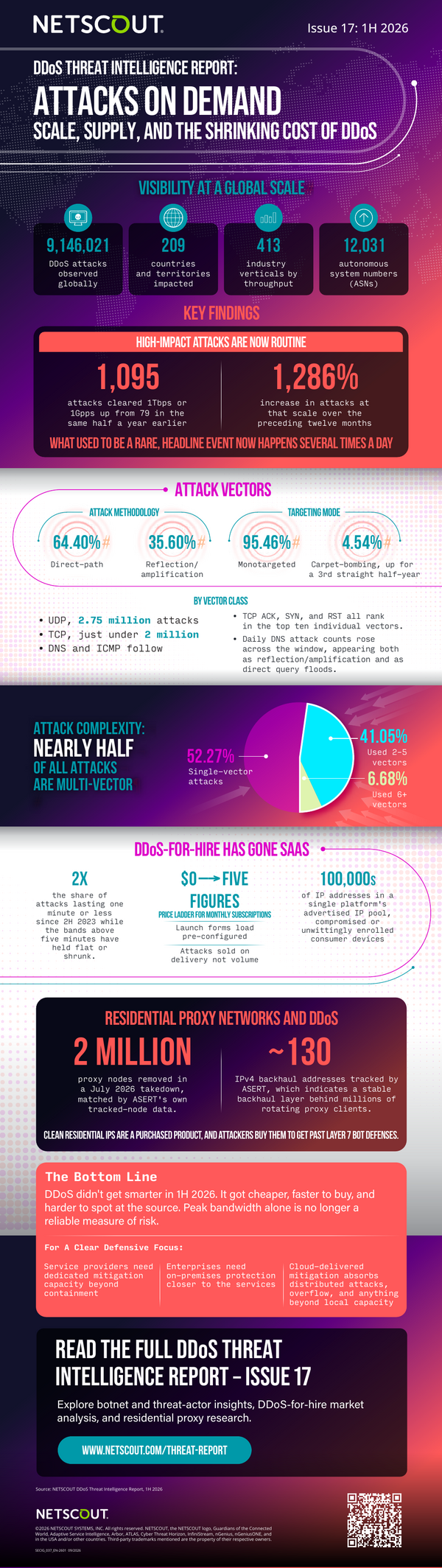
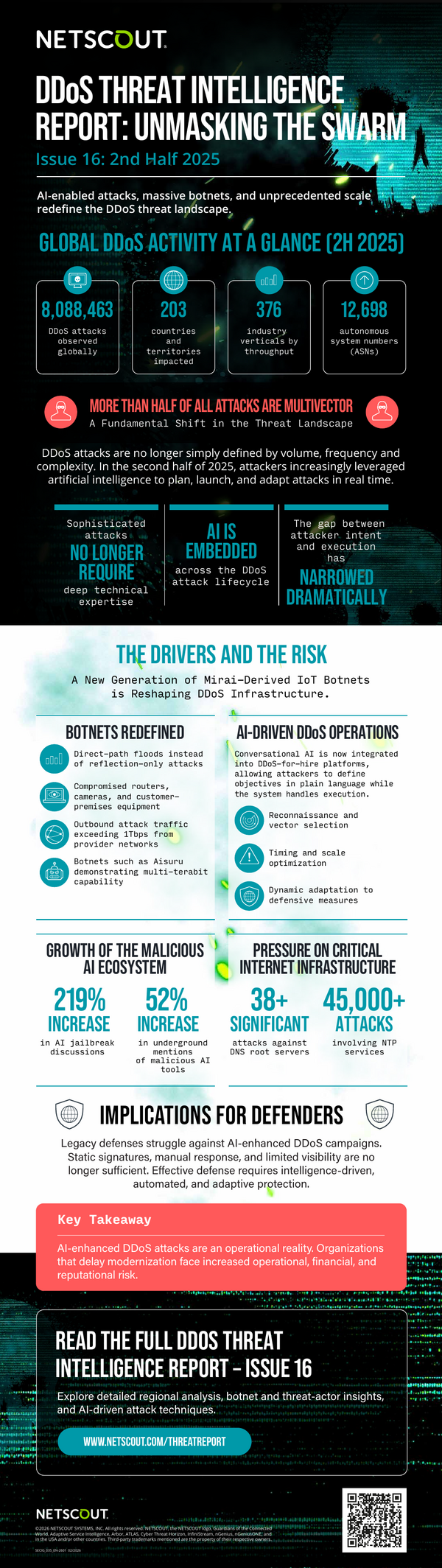
Security teams can learn how DDoS attacks became cheaper, easier to buy, and harder to trace to their source in the first half of 2026, and why peak bandwidth alone no longer measures risk. The infographic summarizes findings from NETSCOUT's DDoS Threat Intelligence Report, Issue 17.
What are the key findings for 1H 2026?
High-impact attacks are now routine. NETSCOUT observed 9,146,021 DDoS attacks worldwide, affecting 209 countries and territories, 413 industry verticals, and 12,031 autonomous system numbers (ASNs). The infographic reports 1,095 attacks that cleared 1 Tbps or 1 Gpps, up from 79 in the same half a year earlier.
How are attacks structured?
About 64.40 percent of attacks were direct-path and 35.60 percent were reflection/amplification. Nearly half of all attacks are multi-vector: 52.27 percent used two to five vectors, 6.68 percent used six or more, and 41.05 percent were single-vector. Carpet-bombing rose for a third straight half-year.
How has DDoS-for-hire changed?
The infographic describes DDoS-for-hire as having gone software-as-a-service (SaaS). Observed changes include:
• Launch forms that load pre-configured
• Attacks sold on delivery rather than volume
• Monthly subscription prices ranging from free to five figures
• Advertised IP pools of hundreds of thousands of compromised or unwittingly enrolled consumer devices
• Residential proxy networks used to get past Layer 7 bot defenses
What defensive focus does the infographic recommend?
It recommends cloud-delivered mitigation for distributed attacks and overflow, on-premises protection closer to services for enterprises, and dedicated mitigation capacity for service providers.
Frequently Asked Questions
Are attacks getting shorter?
Yes. The share of attacks lasting one minute or less has doubled since 2H 2023, while bands above five minutes have held flat or shrunk.
What happened to residential proxy infrastructure?
The infographic notes a July 2026 takedown that removed 2 million proxy nodes, and says ASERT tracks about 130 IPv4 backhaul addresses behind millions of rotating proxy clients.
Asset Type: Infographic