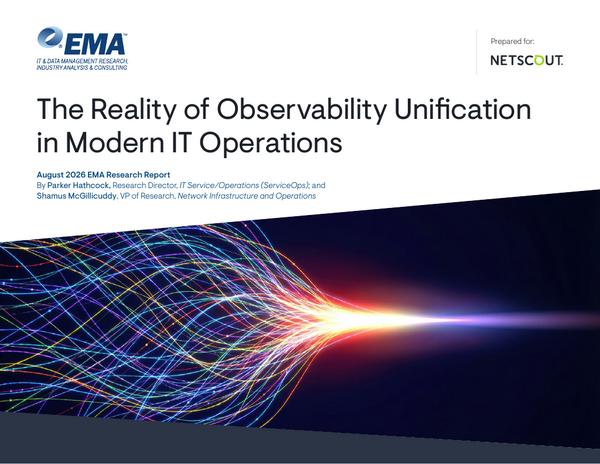




The Reality of Observability Unification in Modern IT Operations
IT operations leaders can use this August 2026 Enterprise Management Associates (EMA) research report to see how organizations unify fragmented observability tools and which practices separate mature organizations from others. The report is based on a survey of 356 IT professionals involved in observability unification initiatives, conducted from May to June 2026.
How widespread is observability tool sprawl?
No organization in the research had consolidated onto a single tool. Most companies use between four and twelve observability or monitoring tools, and companies with 10,000 or more employees are nearly three times as likely as smaller companies to have 13 or more. Larger toolsets correlate with:
• More context switching
• Higher engineering overhead
• Greater integration complexity
• Slower incident response
How far along are unification efforts?
Among organizations pursuing unification, 17.1% have completed it, 51.4% are planning or implementing it, and 31.5% are exploring it. Organizations that completed unification more often report broad AI adoption, real-time mapping of incidents to business service impact, and fewer instances of context switching.
What distinguishes mature organizations?
EMA finds that governance, engineering expertise, operational integration, and collaboration indicate maturity more reliably than company size. Organizations with centralized ownership of observability strategy report fewer tools, stronger integration with IT service management (ServiceOps), and faster incident response.
Frequently Asked Questions
Can outsourcing solve observability tool sprawl?
EMA states that outsourcing a unification strategy will not solve tool sprawl. Organizations with fully staffed observability engineering teams show stronger service visibility, faster mean time to resolution (MTTR), and higher AI adoption.
How does AI relate to observability unification?
EMA says AI-powered IT operations is more mature where organizations already have integrated data, standardized workflows, and shared operational context. AI accelerates mature operating models rather than compensating for fragmented ones.
Asset Type: Reports