

SPARK Matrix: Distributed Denial of Service (DDoS) Mitigation, Q3 2026
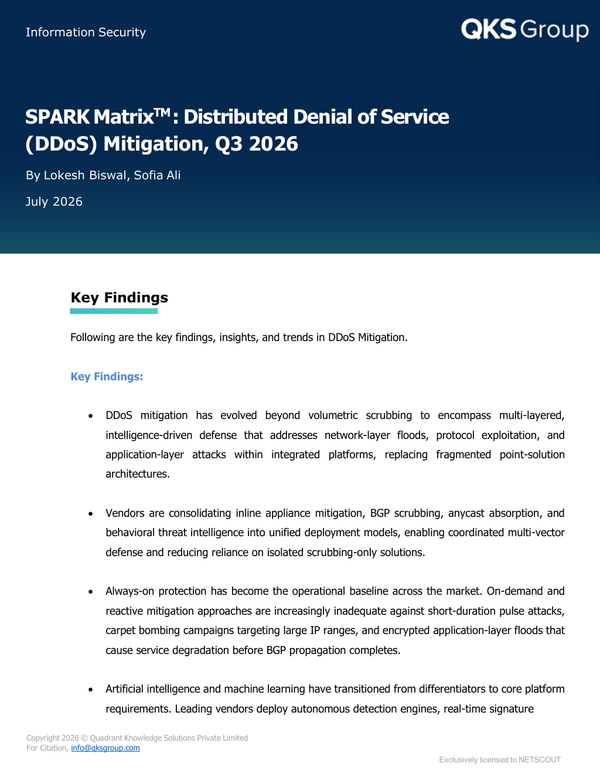
Security and network teams evaluating distributed denial of service (DDoS) mitigation can use this July 2026 QKS Group SPARK Matrix report to understand market trends and how QKS Group evaluates vendors. The report is licensed exclusively to NETSCOUT and includes a profile of NETSCOUT Arbor DDoS Protection.
What trends are shaping DDoS mitigation?
QKS Group says DDoS mitigation has moved beyond volumetric scrubbing toward multi-layered, intelligence-driven defense within integrated platforms. Key trends include:
• AI-driven autonomous mitigation that detects and blocks attacks within seconds
• Encrypted attack protection without full traffic decryption
• Defense against pulse attacks and carpet bombing
• Convergence of DDoS mitigation with web application and API protection (WAAP)
• Carrier and ISP security enablement
Why is always-on protection the baseline?
QKS Group says on-demand and reactive mitigation is increasingly inadequate against short pulse attacks, carpet bombing across large IP ranges, and encrypted application-layer floods that degrade service before Border Gateway Protocol (BGP) propagation completes. Organizations that activate cloud scrubbing only when threshold alerts fire have seen service impact within the first thirty seconds of an attack.
How does QKS Group evaluate DDoS mitigation vendors?
The SPARK Matrix ranks vendors on technology excellence and customer impact. Threat detection and scalable threat mitigation each carry a 20% weighting in technology excellence, while product strategy and performance and market presence each carry 20% in customer impact.
Frequently Asked Questions
What does the report say about Arbor DDoS Protection?
The profile describes a layered defense that combines Arbor Edge Defense, Arbor Sightline, the Threat Mitigation System, and Arbor Cloud with the ATLAS threat intelligence feed. It notes that NETSCOUT's DDoS mitigation focuses on network and infrastructure availability, so organizations needing web application firewall, API security, or advanced bot management will need complementary platforms.
How do regulations affect DDoS mitigation decisions?
The report says regulations in the EU, the United States, and national critical infrastructure frameworks create explicit availability and resilience obligations. These obligations treat DDoS protection as a mandatory operational control.
Asset Type: Reports