

Omnis KlearSight Sensor for Kubernetes
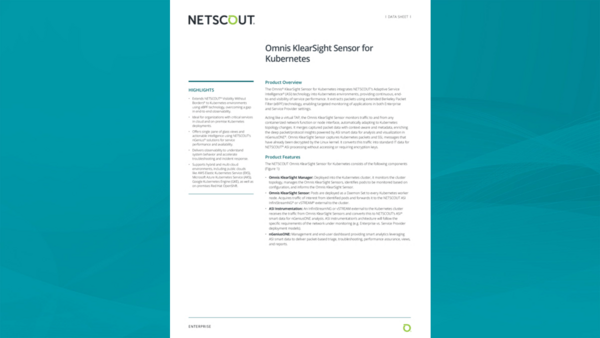
Enterprise and service provider teams running Kubernetes can learn how the Omnis KlearSight Sensor for Kubernetes extends NETSCOUT visibility into containerized environments using extended Berkeley Packet Filter (eBPF) technology. The data sheet explains the components, supported platforms, and how the sensor feeds nGeniusONE.
What is the Omnis KlearSight Sensor for Kubernetes?
The sensor brings Adaptive Service Intelligence (ASI) technology into Kubernetes, giving continuous end-to-end visibility of service performance. It acts like a virtual TAP, monitoring traffic to and from containerized network functions or node interfaces and adapting automatically to Kubernetes topology changes.
Which components make up the solution?
The solution has four components:
• Omnis KlearSight Manager, deployed in the cluster to monitor topology and manage sensors
• Omnis KlearSight Sensor pods, deployed as a Daemon Set on every worker node
• ASI instrumentation, an InfiniStreamNG or vSTREAM outside the cluster that converts traffic to Smart Data
• nGeniusONE, the dashboard for triage, troubleshooting, and reporting
Which platforms are supported?
The sensor supports public cloud managed services AWS Elastic Kubernetes Service, Microsoft Azure Kubernetes Service, and Google Kubernetes Engine. It also supports Red Hat OpenShift Container Platform, OKD, and open-source Kubernetes on premises.
Frequently Asked Questions
Does the sensor need encryption keys?
No. It captures packets and SSL messages already decrypted by the Linux kernel and converts them into standard IT data without accessing or requiring encryption keys.
What does the sensor depend on?
It depends on a NETSCOUT InfiniStreamNG or vSTREAM appliance for Smart Data to be analyzed by nGeniusONE.
Which settings is it designed for?
It targets applications in both enterprise and service provider environments, including hybrid and multi-cloud deployments.
Asset Type: Data Sheet