


Stopping Attacks in Encrypted Traffic with Arbor Edge Defense (AED)
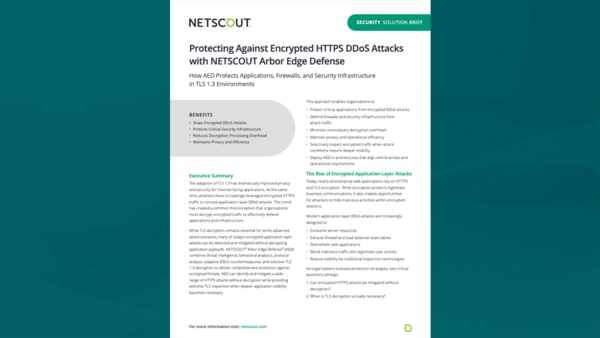
Security teams can learn how NETSCOUT Arbor Edge Defense (AED) stops DDoS attacks hidden in encrypted traffic by decrypting only the traffic that needs inspection. The brief explains why encrypted services are targeted, the categories of attack, and how selective decryption works on premises.
Why are encrypted services targeted by DDoS attacks?
Encrypted services such as online banking, purchases, and government or health care interactions give access to personal and financial data. Attackers increasingly send attacks inside encrypted HTTPS traffic. Decrypting TLS 1.3 traffic requires a proxy, which introduces performance challenges, so encrypted traffic is less likely to be inspected and these attacks are harder to detect.
Which kinds of attacks target encrypted services?
The brief describes four categories:
• Attacks on the SSL/TLS handshake negotiation
• Protocol or connection attacks against SSL service ports
• Volumetric attacks that overwhelm SSL/TLS service ports with high-volume floods
• Application-layer attacks against the service running over SSL/TLS
How does AED use selective decryption?
AED sits at the network edge and learns which clients are legitimate. Traffic from valid clients passes without decryption, and the remaining non-validated traffic goes through a TLS proxy to be decrypted and evaluated by DDoS countermeasures. Decryption can be enabled per protected service or protection level, so effort is focused on traffic that needs it and decryption capacity is not overwhelmed.
Frequently Asked Questions
Why does the brief favor on-premises decryption?
Many organizations do not want traffic decrypted off site or by a cloud service, because that may require sharing private certificates with the provider and creates risk to private keys.
Is decryption always required for mitigation?
No. The brief states that decryption is not always necessary for successful mitigation, but there is a growing need for scalable decryption that exposes malicious traffic.
Asset Type: Solution Brief