
Protecting Stateful Security Stack Devices with Arbor Edge Defense (AED) and ATLAS Intelligence Feed (AIF)
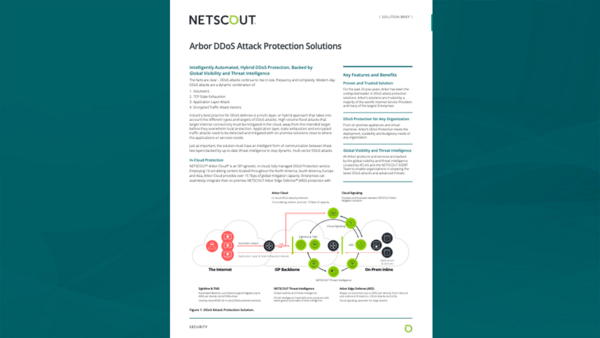
Security and network teams can learn how NETSCOUT Arbor Edge Defense (AED) and the ATLAS Intelligence Feed (AIF) protect stateful security devices from state-exhaustion DDoS attacks and unwanted traffic. The brief explains the two challenges, the stateful devices at risk, and the capabilities that reduce load on the security stack.
What challenges affect stateful security stack devices?
The first challenge is state-exhaustion DDoS attacks, especially TCP flood attacks. The attacker floods a device with SYN messages that never complete the handshake, filling the limited TCP state table until the device stops accepting new connections. The second is excessive malicious and nuisance traffic, which loads firewalls, intrusion detection and prevention systems (IDS/IPS), and web application firewalls (WAFs) even when they are not the target and can lead to costly capacity upgrades.
Which devices can be overwhelmed?
Any device that keeps a TCP state table can bring traffic to a halt, including:
• Firewalls, next-generation firewalls, and WAFs
• IDS/IPS
• Load balancers and proxy servers
• VPN gateways and WAN optimizers
• Some advanced routers
How do AED and AIF help?
AED is a stateless packet processing solution at the network edge, so it is not susceptible to state exhaustion. With threat intelligence from AIF, it blocks inbound traffic such as scanning, brute force attempts, exploit attempts, malformed packets, and traffic from untrustworthy networks. It also blocks inbound and outbound botnet command and control, malware download sites, data exfiltration destinations, and other indicators of compromise. This reduces load on the security stack and helps avoid unnecessary capacity upgrades.
Frequently Asked Questions
What happens when a large attack saturates the internet circuit?
AED's cloud signaling can automatically route traffic to a cloud-based DDoS service such as NETSCOUT Arbor Cloud or one from an ISP.
What strategy does the brief recommend?
It recommends a layered, hybrid defense that includes a dedicated, stateless DDoS solution at the network edge instead of relying only on stateful security devices.
Asset Type: Solution Brief