
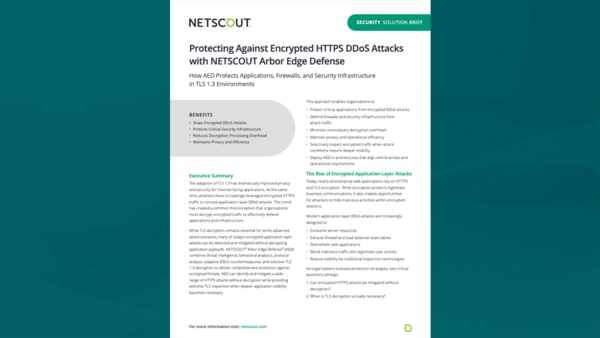
Protecting Against Encrypted HTTPS DDoS Attacks with NETSCOUT Arbor Edge Defense
Security teams can learn which encrypted HTTPS DDoS attacks NETSCOUT Arbor Edge Defense (AED) stops without decrypting traffic, when selective TLS 1.3 decryption is needed, and which deployment architectures support each approach. The brief addresses the common view that all encrypted traffic must be decrypted to defend applications.
Can encrypted HTTPS DDoS attacks be mitigated without decryption?
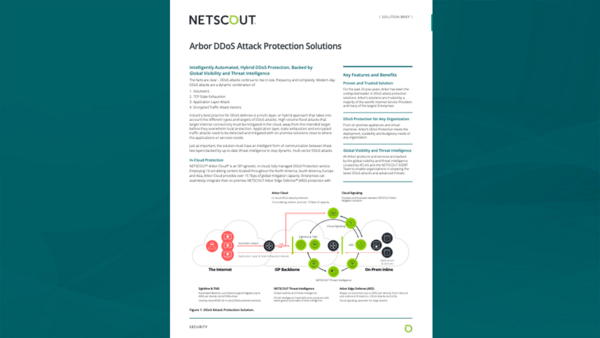
Many can. Application flooding and state exhaustion attacks, such as HTTPS GET and POST floods, TLS handshake abuse, and low-and-slow connection attacks, usually show their intent through connection behavior, transaction rates, and protocol anomalies. AED uses these non-decrypting protections:
• Threat intelligence and reputation-based blocking of known botnets and abused open proxies
• Rate-based behavioral detection of abnormal transaction and connection rates
• TCP Idle Protection against low-and-slow state exhaustion
• TLS Handshake Analysis of negotiation, renegotiation, and protocol anomalies
When is TLS decryption necessary?
Stealthy application-layer attacks, such as user-emulation botnets, URI-targeted attacks, session-oriented attacks, and low-rate distributed attacks, can look legitimate at Layers 3 and 4. Their indicators may appear only inside encrypted transactions, so AED offers selective TLS 1.3 decryption through a transparent TLS proxy. Decryption requires visibility into both directions of traffic, so asymmetric routing prevents TLS inspection.
Which deployment architectures does the brief describe?
The brief describes three options. AED at the edge, between the edge router and firewall, protects security infrastructure and supports TLS inspection when routing is symmetric. AED adjacent to applications supports TLS inspection but leaves upstream stateful devices exposed. A dual-AED design combines edge protection with application-tier inspection and suits asymmetric environments.
Frequently Asked Questions
Why does selective decryption matter?
It focuses inspection on traffic that needs deeper analysis, which reduces processing overhead and privacy exposure while behavioral protections handle most encrypted attacks.
What does the brief recommend for asymmetric routing?
It recommends first engineering symmetric routing so AED can stay at the edge. If that is not possible, it recommends placing AED next to applications or using the dual-AED architecture.
Asset Type: Solution Brief