
NETSCOUT Integrates Smart DDoS Protection With Cortex XSOAR
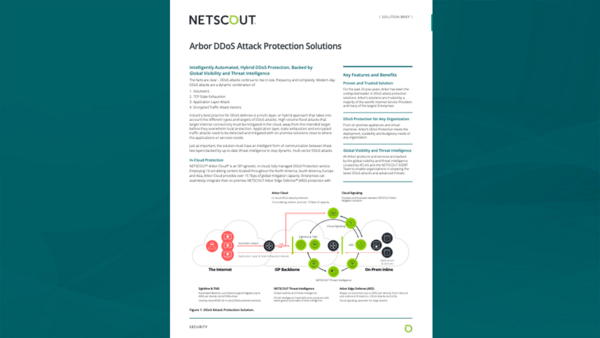
Security operations teams can learn how Arbor Sightline and Arbor Edge Defense (AED) integrate with Palo Alto Networks Cortex XSOAR to orchestrate DDoS and threat response. The brief explains the integration and three use cases for inbound attacks, outbound attacks, and outbound threat indicators.
Why integrate DDoS protection with a SOAR platform?
Without orchestration, DDoS tools and Cortex XSOAR work independently, each unaware of the other's detection and mitigation, which adds overhead for security teams. The brief also explains that stateful devices such as next-generation firewalls need protection from attack traffic, and that AED sits at the network edge in front of firewalls with a stateless design.
How does the integration work?
Arbor Sightline sends incident reports of endpoint alerts, Threat Mitigation System (TMS) mitigations, and FlowSpec mitigations to Cortex XSOAR. XSOAR can then run actions or trigger automation to change enforcement. Operators can also use indicators in XSOAR to start mitigation manually. The integration is certified through Palo Alto Networks and available on the Cortex XSOAR Marketplace.
Which use cases does the brief describe?
Three use cases are described:
• Inbound DDoS attack: Sightline detects the attack, and XSOAR automates mitigation to TMS, AED, and other devices
• Outbound DDoS attack: internal resources taking part in an attack are identified and blocked nearer the source
• Outbound threat indicator: command-and-control traffic is identified, other devices block it, and the endpoint detection and response (EDR) tool quarantines the host
Frequently Asked Questions
What does AED provide to XSOAR?
AED can provide hosts, countries, domains, and URLs from an attack to be blocked, and hosts and countries from its outbound blacklist.
Is a free version of Cortex XSOAR available?
The brief states that a free Community Edition can be downloaded.
Asset Type: Solution Brief