
NETSCOUT and Splunk Better Together: Empowering Healthcare IT to Deliver Care Without Compromise
Healthcare IT leaders can learn how NETSCOUT Smart Data and Splunk combine to improve observability, reliability, and resilience for clinical services. The brief explains why metrics, events, logs, and traces (MELT) leave gaps and presents four healthcare use cases.
Why do healthcare organizations need more than MELT data?
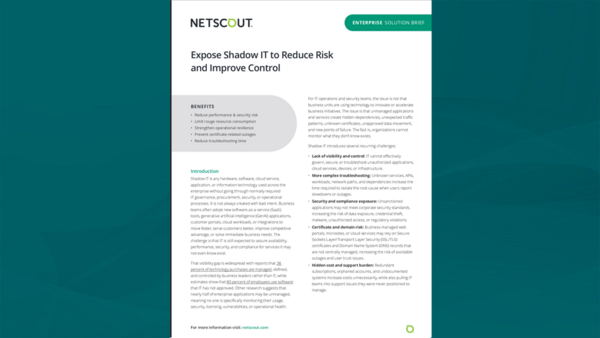
Healthcare IT teams face rapid data growth, expanding cloud and application footprints, and unsanctioned tools that strain visibility and raise risks to compliance, security, performance, and clinical decision-making. Deep packet inspection (DPI) metadata can close blind spots that MELT data leaves. NETSCOUT Smart Data enriches MELT and, when integrated with Splunk, supports analytics, dashboards, and AI-driven insights.
What healthcare use cases does the brief describe?
The brief describes four use cases:
• Detecting Shadow IT and assuring patient care with Fast Healthcare Interoperability Resources (FHIR) certificate monitoring
• Migrating Epic clients on virtual desktop infrastructure (VDI) to a new local client, with before-and-after comparisons
• Visibility across internal and business-to-business workflows that use HL7 and FHIR data exchange
• Performance of hospital sites and critical departments, including EHR and imaging systems
How do NETSCOUT and Splunk work together?
NETSCOUT captures packet-level telemetry on response times, failed connections, latency, retransmissions, and certificate anomalies. Splunk correlates that telemetry with MELT data in Splunk IT Service Intelligence (ITSI) or Enterprise Security (ES), producing dashboards, alerting, health scoring, and reporting for faster investigation and reduced mean time to resolution (MTTR).
Frequently Asked Questions
How does the solution help with certificate problems?
NETSCOUT monitors traffic patterns and message response times and detects expiring or misconfigured certificates, helping teams find TLS handshake and certificate errors that disrupt FHIR communications or SaaS services.
What does Smart Data capture?
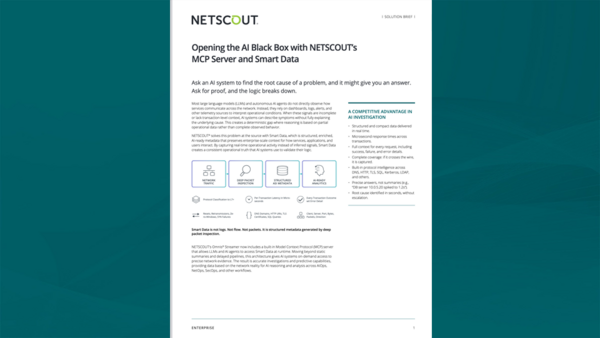
Smart Data covers who is talking to whom and on what protocol, including DNS requests, login attempts, HTTP URLs, TLS handshakes, LDAP, SMTP, and TCP statistics.
Asset Type: Solution Brief