
Why CDNs Alone Are Not Enough for Advanced DDoS Protection
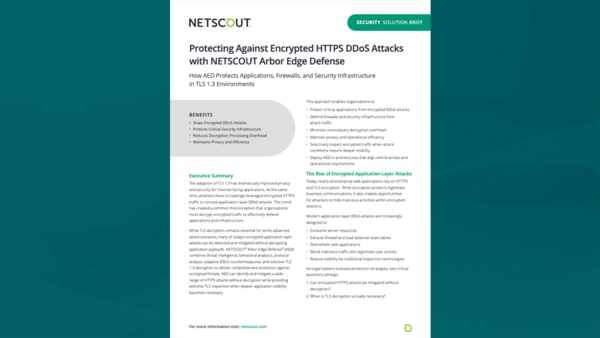
Security and network teams can learn why content delivery networks (CDNs) leave gaps in DDoS protection and how NETSCOUT Arbor Edge Defense (AED) with CDN-Aware mitigation closes them. The brief recommends combining a CDN with dedicated on-premises DDoS protection in a coordinated hybrid architecture.
What can CDNs not protect against?
CDNs were built for performance, and their DDoS protection covers only traffic that flows through the CDN. The brief lists these exposures:
• Non-HTTP/S traffic such as DNS, VoIP, email, RDP, and SQL
• Direct-to-origin IP attacks that bypass the CDN
• CDN exploit attacks, where the CDN forwards an HTTP flood
• Any asset not explicitly routed through the CDN
How does AED CDN-Aware mitigation work?
Traffic from a CDN arrives with the CDN proxy IP address instead of the real client IP, so per-user rate limiting is difficult. AED identifies CDN proxy connections, decrypts the TLS session, and extracts the real client IP from headers such as True-Client-IP or X-Forwarded-For. It then applies rate limits, HTTP challenges, and blocks per client while preserving the persistent TLS session, so legitimate users are not affected.
What is the multilayer hybrid protection strategy?
The brief frames the answer as CDN and AED rather than CDN versus AED. The CDN absorbs volumetric HTTP/S floods at the edge, AED protects the origin and the vectors the CDN cannot see, and Arbor Cloud provides volumetric mitigation for attacks that exceed on-premises capacity.
Frequently Asked Questions
How does AED detect CDN proxy traffic?
AED uses four methods: published CDN IP ranges, Autonomous System Number lookup, reverse DNS lookup, and HTTP header signals after decryption.
What does a direct-to-origin attack mean?
An attacker discovers the origin server IP address and sends traffic straight to it, bypassing the CDN. AED then sees the real attacker IP and applies its standard countermeasures.
Asset Type: Solution Brief