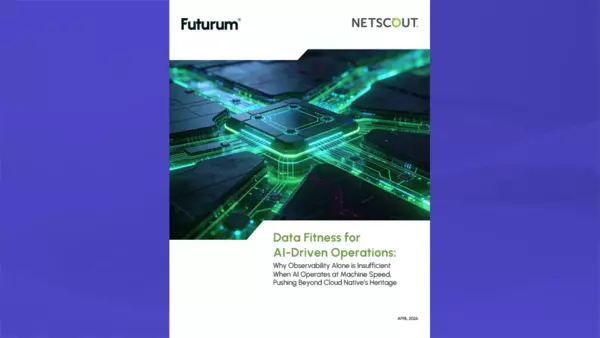

Data Fitness for AI-Driven Operations: Why Observability Alone is Insufficient When AI Operates at Machine Speed, Pushing Beyond Cloud Native’s Heritage
Technology and operations leaders can use this April 2026 Futurum report, produced with NETSCOUT, to assess whether their operational data is fit for AI that acts autonomously at machine speed. It defines data fitness, lists six attributes of fit-for-purpose operational data, and explains how network-derived telemetry addresses an interaction visibility gap.
What is data fitness?
Data fitness describes input quality for AI-assisted and autonomous workflows: the confidence that data consumed by AI supports reliable action, not just retrospective analysis. The report contrasts it with data quality, which measures only correctness, and observability maturity, which measures coverage.
What attributes make operational data fit for AI?
The report defines six core attributes: fidelity, timeliness, context, provenance, consistency, and coverage. Fidelity means observed interactions provide higher confidence than instrumented abstractions, and context means causality and sequence rather than state alone.
Why do traditional observability tradeoffs create risk for AI?
Traditional observability relies on sampling, aggregation, and application instrumentation, which suited human investigators. As AI-driven workflows narrow the margin for error, the report names three risks:
• Sampling creates visibility gaps AI cannot fill without human judgment
• Aggregated metrics obscure the causality AI needs
• Instrumentation bias means AI sees only what developers anticipated
How does network-derived telemetry address the gap?
The report says network-derived telemetry observes actual interactions on the wire, including which services communicated, when, in what sequence, and with what protocols. It describes NETSCOUT's approach as extracting distilled metadata rather than retaining raw packets.
Frequently Asked Questions
How does autonomy relate to telemetry confidence?
The report says higher autonomy demands higher telemetry confidence. It distinguishes AI-assisted operations, which keep humans in the loop, from agentic operations, which remove immediate human intervention.
What does the Futurum survey show about AI observability?
Futurum's 2026 Software Lifecycle Engineering Decision-Maker Survey shows 37.4% of organizations prioritize AI observability in platform selection, and 30.9% prioritize AI agent observability.
Asset Type: Reports